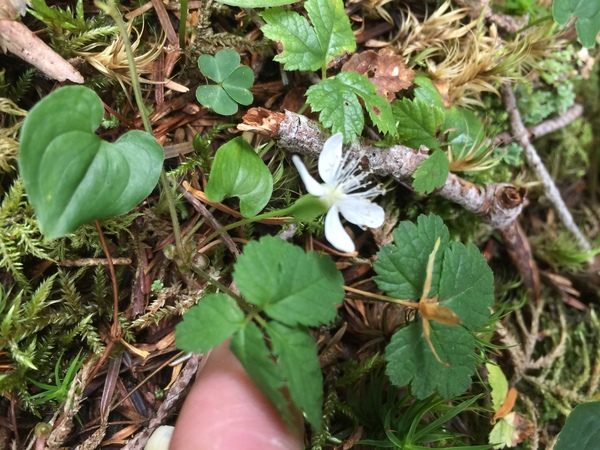
Japanese name: コガネイチゴ(黄金苺) Scientific name:Rubus pedatus
[Overview]
An evergreen perennial found in subalpine coniferous forests and under Japanese stone pine in the alpine zone.
The stems are thin and wiry, creep along the ground, and produce roots from the nodes.
The stems are hairy when young and have no thorns.
The leaves are alternate and trifoliate, but the 2-lobed lateral leaflets sometimes divide completely, giving 5 leaflets in a bird's-foot arrangement.
The terminal leaflet is ovate, 1.5–3 cm long and 1–2 cm wide, with a double-serrate or notched-serrate margin.
The petiole has soft hairs, sometimes mixed with glandular hairs.
The stipules are entire.
A flower stalk 3–12 cm long arises from the leaf axil and bears 1–2 leaves at its base.
The flowers are white, 4–5-petaled, 1.5–2 cm across, and borne singly and facing upward at the tip of the flower stalk.
The pedicel is 3–10 cm long and densely covered with short soft hairs, sometimes mixed with glandular hairs.
The calyx has soft hairs.
The fruit is an aggregate fruit with few small fruits and ripens red.