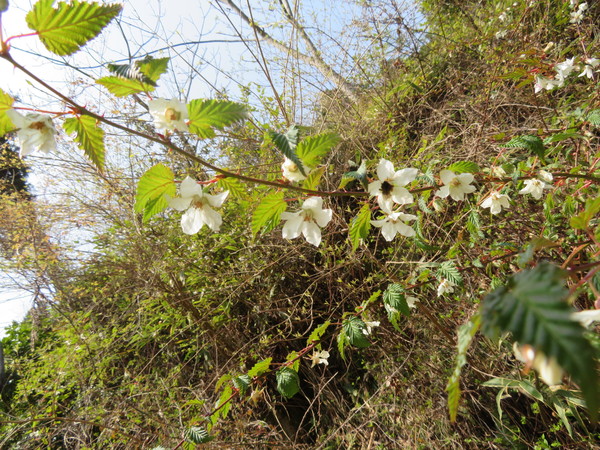
Rubus palmatus var. palmatus("Nagabamomijiichigo")
Japanese name: ナガバモミジイチゴ(長葉紅葉苺) Scientific name:Rubus palmatus var. palmatus
[Overview]
A deciduous shrub about 2 m tall, found in bright woods and at forest edges.
The stems branch and bear many hooked thorns.
Branches in their first and second years are green.
The leaves are alternate and long-ovate, usually divided into 3–5 lobes with the central lobe elongated, though the way they are cut varies.
There are hairs on the veins of the undersides of the leaves, and the margins have notches and serrations.
The leaf stalks have hooked thorns.
On flowering branches bearing a few leaves, 1–3 flowers hang down.
The small flower stalks are hairy.
The flowers are white and 5-petaled, about 3 cm across.
The calyx is hairy.
The fruit is a spherical aggregate fruit that ripens orange-yellow and is edible.
[Cultivation]
Propagate by cuttings.
It prefers sun to partial shade and soil that is well drained and retains water well.
It is easy to grow.
Water thoroughly when the soil surface dries.
Little fertilizer is needed, but organic fertilizer may be applied in winter.
There are no particular pests or diseases.