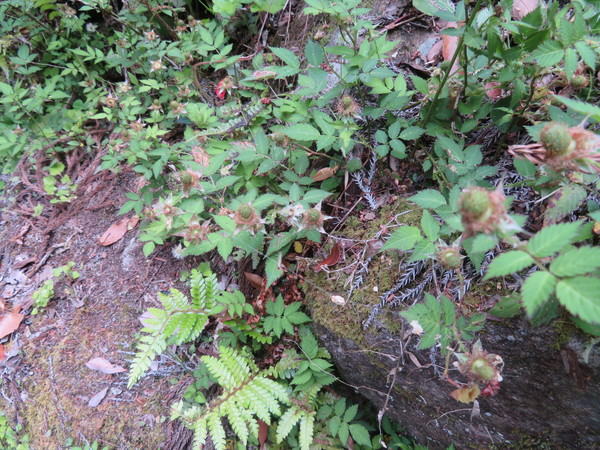
Japanese name: ヒメバライチゴ(姫薔薇苺) Scientific name:Rubus minusculus
[Overview]
A deciduous low shrub 20–60 cm tall, found in sunny places such as the edges of deciduous forests.
Young branches, the undersides of the leaves, the calyx and other parts have disc-shaped yellow glandular dots.
The stems have upward-pointing hooked thorns.
The leaves are alternate and odd-pinnately compound, consisting of 5–7 leaflets.
The terminal leaflet is slightly larger than the lateral leaflets; the leaflets are broadly lanceolate to ovate, 1–3 cm long, with doubly serrated margins.
Both surfaces of the leaves have short hairs, especially numerous on the veins of the underside.
The leaf stalk is densely covered with soft hairs and sparsely armed with thorns.
The first-year stem bears only leaves, and in the following year flowering branches grow from the sides at the nodes of that stem.
A single white 5-petaled flower 3–4 cm across is borne at the branch tip.
The sepals have tail-like pointed tips, with soft hairs and disc-shaped glandular dots on the outside and cottony hairs on the inside.
The flower stalk is 2–3 cm long and densely covered with soft hairs.
The fruit is a spherical aggregate fruit about 1.5 cm across that ripens crimson and is edible.