
Plant Encyclopedia

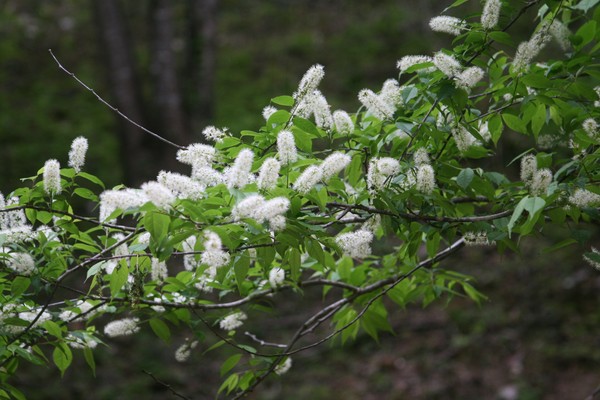
Padus grayana (Japanese bird cherry, "Uwamizuzakura")
Japanese name: ウワミズザクラ (上溝桜)
Scientific name: Padus grayana
[Overview]
A deciduous tree up to 15 m tall with a trunk 50 cm in diameter, found in sunny mountain valleys.
The bark is purple-brown and glossy, and it is said that a bad smell comes from the branches when they are damaged.
The leaves are simple and alternate, oblong, 8–11 cm long, abruptly pointed at the tip, and serrated along the margin.
The nectar glands are at the base of the leaf.
The petiole is 0.7–1 cm long.
Racemes 8–10 cm long emerge at the branch tips.
Several leaves are borne below the inflorescence.
The flowers open after the leaves have expanded; they are about 0.6 cm across, white, with 5 petals.
There are many stamens, which project beyond the petals.
The fruit is ovoid, 0.6–0.7 cm long, ripens from red to blackish purple, and is sweet.
It resembles Ezo-no-uwamizuzakura, but can be distinguished by the nectar glands at the base of the leaf and the stamens being longer than the petals, among other points.
[Uses]
The buds are used medicinally.
The young flower spikes and unripe fruits can be eaten salted.
The fruit is made into fruit liqueur.
The wood is used for construction, utensils, carving and similar purposes, and the bark is used for crafts.
It is also used as a dye.
[Cultivation]
Propagate from seed or cuttings.
It prefers sunny, well-drained, fertile soil.
For fertilizer in winter, dig holes around the plant and bury organic fertilizer.
[Notes]
The Japanese name is said to derive from the use of this tree in divination, with grooves carved into it.
Details
Japanese: ウワミズザクラ(上溝桜)、クソザクラ、ヨグソザクラ
Translated from our Japanese encyclopedia. If anything differs, the Japanese page is correct.