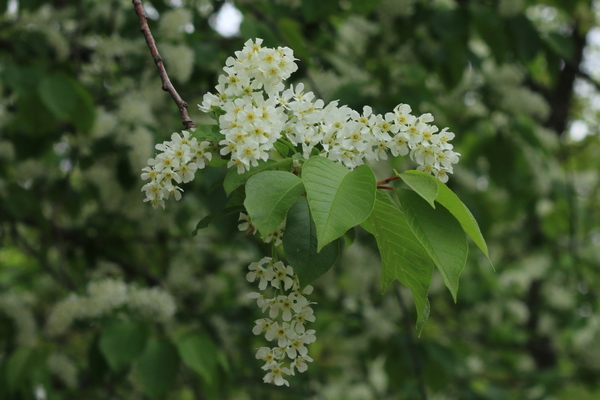
Japanese name: エゾノウワミズザクラ(蝦夷上溝桜) Scientific name:Padus avium var. avium
[Overview]
A deciduous tree 15 m tall.
The bark is purplish brown and slightly glossy.
Leaves are simple and alternate, obovate, 6–9 cm long, abruptly pointed at the tip, with serrated margins.
The petiole is 1.7–2 cm long and has nectary glands on its upper part.
Racemes 6–8.5 cm long arise at the branch tips.
The branch bearing the raceme, including the raceme, is 9–12 cm long and carries several leaves below the raceme.
The flowers open after the leaves unfold; they are white, five-petaled and about 1.4 cm across.
There are many stamens, clearly shorter than the petals.
The fruit is an ovoid-globose drupe 6–7 mm long, ripening black.
[Uses]
The liquid obtained by steam distillation of the buds and leaves, and the bark, are used medicinally.
[Notes]
It resembles Uwamizu-zakura but can be distinguished by the nectary glands on the upper part of the petiole and the stamens being clearly shorter than the petals.