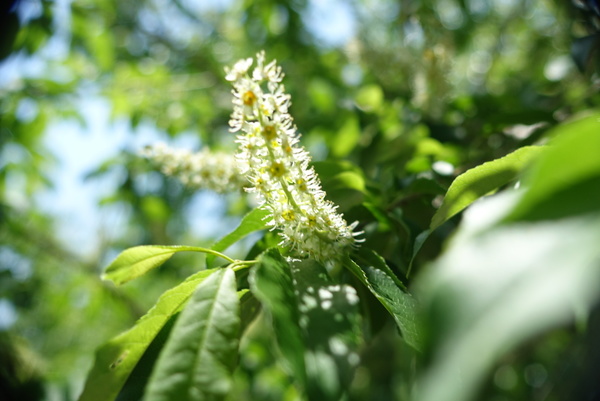
Japanese name: イヌザクラ(犬桜) Scientific name:Padus buergeriana
[Overview]
A deciduous tree 10 m tall, found in mountain areas.
The bark is dark gray and glossy, and a foul smell is said to come from injured branches.
Young branches are green and hairy.
Leaves are simple and alternate, elliptic, 5–8.5 cm long, abruptly pointed at the tip, with serrated margins.
The nectary glands are at the base of the leaf.
The petiole is 1–1.5 cm long.
Racemes 6–9 cm long arise at the branch tips.
The raceme axis is densely covered with short hairs.
There are no leaves below the raceme.
The flowers open after the leaves unfold; they are white, five-petaled and about 0.5 cm across.
There are many stamens, which protrude beyond the petals.
The fruit is an ovoid-globose drupe 0.6–0.7 cm long, ripening black and sweet.
[Uses]
The wood is used for construction and crafts.
[Cultivation]
Propagate from seed or by cuttings.
It prefers fertile soil with good sun and drainage.
For fertilizer in winter, dig holes around the plant and bury organic fertilizer.