
Plant Encyclopedia

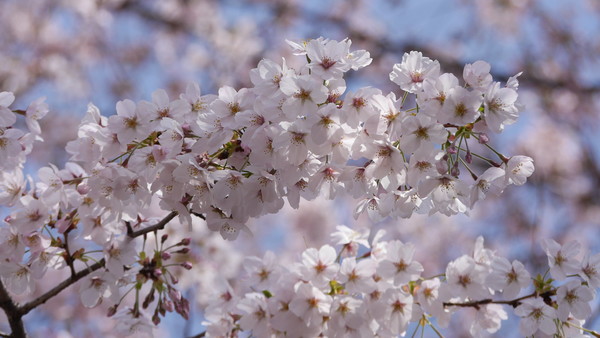
Cerasus ×yedoensis (Yoshino cherry, "Someiyoshino")
Japanese name: ソメイヨシノ (染井吉野)
Scientific name: Cerasus ×yedoensis
[Overview]
As a species, Somei-yoshino is a deciduous tree regarded as a hybrid of Edo-higan and Oshima-zakura, and it varies from forms resembling Edo-higan to forms resembling Oshima-zakura.
The widely planted Somei-yoshino is the cultivar 'Somei-yoshino' (Cerasus ×yedoensis 'Somei-yoshino') among them.
The cultivar 'Somei-yoshino' is a deciduous tree reaching 12 m in height and 1 m in trunk diameter.
The branches spread horizontally, giving an umbrella-shaped crown.
The bark is grayish brown and smooth, with conspicuous horizontally elongated lenticels.
Young branches are hairy at first.
The young shoots are tinged reddish brown.
The leaves are elliptic to obovate-oblong, 7–11 cm long and 4–7 cm wide, with a pointed tip and sharp double serrations.
The leaf base is rounded to truncate.
The upper surface of the leaf is glossy, and the lower surface has sparse hairs.
The petiole is 2–3 cm long with slightly ascending hairs, and 1–2 nectar glands are attached to its upper part.
The flowers open before the leaves appear.
The flowers are borne 3–5 in umbels arising from the leaf axils; they are 5-petaled, pale pink at first and later white, 3–3.8 cm across.
The petals are broadly elliptic to obovate-elliptic, about 1.5 cm long.
There are about 35 stamens, of almost the same length as the style.
The style is longer than the ovary and is hairy in its lower half.
The calyx tube is tubular and urn-shaped, with little constriction at the top.
The calyx lobes are lanceolate and toothed, and spread open at flowering.
Both the calyx tube and calyx lobes are densely hairy.
The pedicel is 2–2.5 cm long.
The outside of the bracts is densely covered with short erect hairs, and the lower half of the inside has long hairs.
The scale leaves are also hairy on both the inner and outer surfaces.
The fruit is spherical, 1–1.2 cm across, and ripens to black.
It is a cultivar that arose when Oshima-zakura crossed with Edo-higan as the mother plant, and it is said to have been put on sale by a nurseryman in Somei Village, Tokyo (now Komagome), at the end of the Edo period.
The name was given in 1900 by Fujii Kimei.
Because 'Somei-yoshino' is propagated by grafting, all plants are clones.
Cultivars with 'Somei-yoshino' as one parent (such as 'America') are linked to the species Somei-yoshino.
[Cultivation]
Propagate by cuttings or grafting.
It prefers a sunny, well-drained site.
If it becomes a problem by growing into a large tree in a garden, it is good to control its size by restricting the space available to the roots with a fabric pot.
While it is a young tree, protect it from frost by spreading straw around the base, for example.
Also, it is better not to cut branches needlessly if there is no need.
It has many pests and diseases, so care is needed.
Details
Japanese: ソメイヨシノ(染井吉野)、ヨシノザクラ(吉野桜)
Translated from our Japanese encyclopedia. If anything differs, the Japanese page is correct.