
Plant Encyclopedia

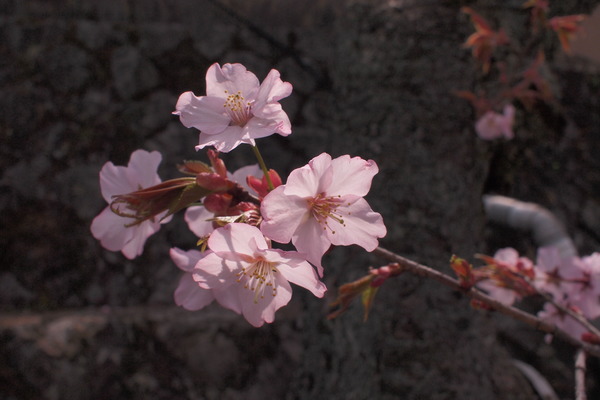
Cerasus sargentii var. sargentii (Sargent's cherry, "Oyamazakura")
Japanese name: オオヤマザクラ (大山桜)
Scientific name: Cerasus sargentii var. sargentii
[Overview]
A deciduous tree 20–25 m tall. It grows in forests and at forest edges in the mountains, and in regions where its range overlaps with Yama-zakura and Kasumi-zakura, it tends to grow at higher elevations.
The bark is dark purplish brown, with conspicuous horizontally elongated lenticels.
The leaves are alternate, ovate to obovate-elliptic, 8–15 cm long and 4–8 cm wide, with sharp serrations on the margin ending in glands, some of the serrations being double.
The undersides of the leaves are tinged with powdery white.
Young leaves are tinged with reddish brown.
The petiole is 1.5–2.5 cm long, hairless, and has nectar glands in its upper part.
The flowers are borne 1–3 per umbel emerging from the leaf axils, and are pale pink with 5 petals.
They open before the leaves emerge or at the same time, measure 3.2–4 cm across, and are faintly fragrant.
The fruit is spherical, about 1 cm across, and ripens to blackish purple.
[Cultivation]
Propagate from seed, by cuttings, or by grafting.
It prefers a sunny, well-drained site.
If a large tree would be a problem in a garden planting, it is good to limit the space for root growth with a fabric pot in order to control the size of the tree.
While it is a young tree, protect it from frost by spreading straw around the base.
Also, it is better not to cut the branches needlessly if it is not necessary.
It is prone to many pests and diseases, so care is needed.
Details
Japanese: オオヤマザクラ(大山桜)、エゾヤマザクラ(蝦夷山桜)、ベニヤマザクラ(紅山桜)
Translated from our Japanese encyclopedia. If anything differs, the Japanese page is correct.