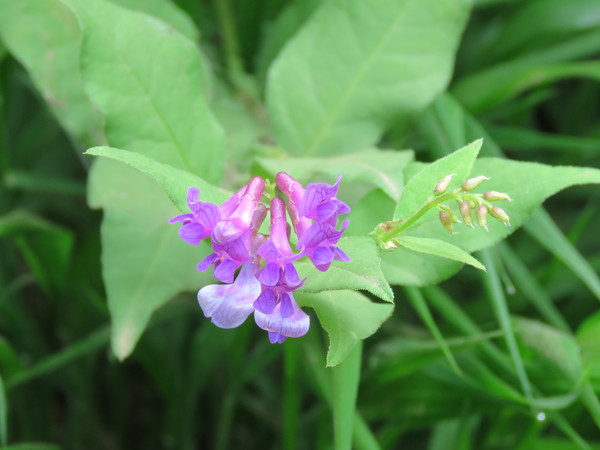
Japanese name: ナンテンハギ(南天萩) Scientific name:Vicia unijuga var. unijuga
[Overview]
A perennial 50–100 cm tall, found in grasslands, along roadsides, and at forest edges.
It has a thick rhizome.
The stem is ridged, rises obliquely, and bends slightly in a zigzag in the upper part.
The leaves are alternate and even-pinnately compound, consisting of 2 leaflets.
The leaflets are ovate, 4–7 cm long and 1.5–4 cm wide, but the leaf shape varies.
The petiole is short, and stipules are attached at its base.
The stipules are toothed or 2-lobed.
No tendril develops at the leaf tip.
Racemes 3–10 cm long arise from the leaf axils and bear 10 or more flowers.
The flowers are reddish-purple pea-shaped flowers 1.2–1.8 cm long.
The fruit is a legume 2.5–3 cm long and 0.6 cm wide, containing 3–7 seeds.
The seeds are spherical, about 3 mm in diameter.
[Uses]
The young shoots can be eaten as a wild vegetable.
The whole plant in the flowering period is also used as a folk medicine.