
Plant Encyclopedia

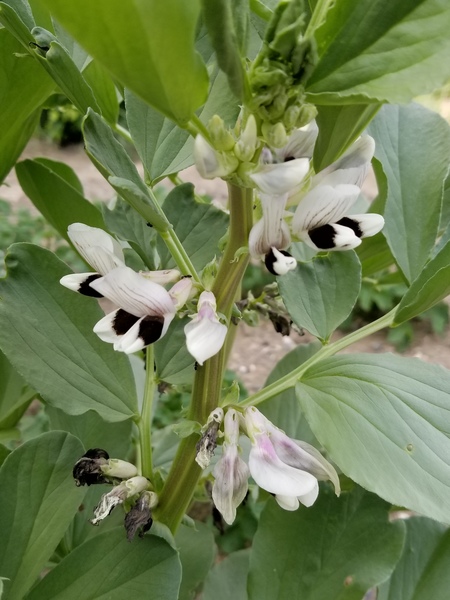
Vicia faba (broad bean, "Soramame")
Japanese name: ソラマメ (蚕豆、空豆)
Scientific name: Vicia faba
[Overview]
An erect annual or biennial 50–100 cm tall.
The stem branches well from the base, and is square in cross section and hollow.
Leaves are alternate and evenly pinnately compound.
The leaf axils bear 1–5 pea-shaped flowers about 3 cm across, white to pale purple with black blotches.
The fruit is a flat, oblong pod 10–30 cm long, borne upright.
The seeds (beans) number 2–4 per pod, and are large and flat, kidney-shaped.
[History]
It has been cultivated since ancient times, and its origin is thought to be the Mediterranean coast region from North Africa to southwestern Asia, and South Asia.
[Cultivation]
In Kanto and areas to the south, sow in autumn; in high-altitude and cold regions, sow in spring. Sow directly, though it is also possible to germinate seeds in plastic pots and plant out while the seedlings are small.
The optimum growing temperature is 16–20°C; growth declines above 20°C, and after flower buds appear it is also sensitive to cold.
It also dislikes dry soil.
Grow it in a sunny, well-drained place.
Pests and diseases include damping-off, mosaic disease, chocolate spot, ring spot, rust, brown spot, aphids and broad bean weevils.
Care is also needed against problems from continuous cropping.
[Notes]
It is said to be written 空豆 ("sky bean") because the pods grow pointing toward the sky, and 蚕豆 ("silkworm bean") because it ripens when silkworms make their cocoons, or because the young pods are shaped like silkworms.
Details
Japanese: ソラマメ(蚕豆、空豆)、ノラマメ(野良豆)、ナツマメ(夏豆)、コヤマメ(高野豆)、テンマメ(天豆)、シガツマメ(四月豆)
Translated from our Japanese encyclopedia. If anything differs, the Japanese page is correct.