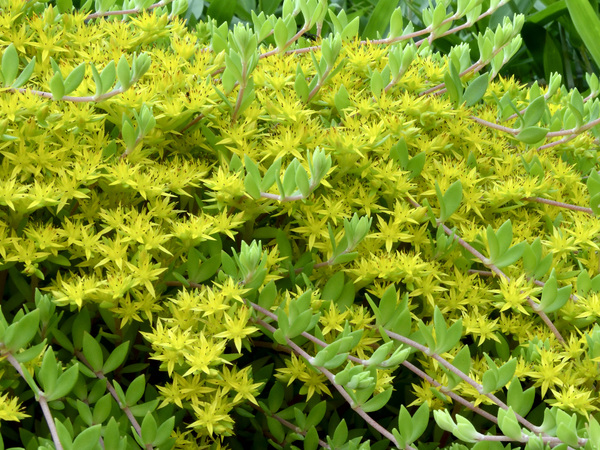
Japanese name: ツルマンネングサ(蔓万年草) Scientific name:Sedum sarmentosum
[Overview]
A perennial found on stone walls and riverbanks in urban areas.
The non-flowering stems are long and creeping, tinged with crimson.
The leaves are simple and borne in whorls of 3; they are elliptic to lanceolate, 1.3–2.5 cm long and 0.3–0.8 cm wide, and fleshy.
The leaves may also be alternate or opposite.
A trichotomous cymose inflorescence at the stem tip bears yellow, 5-petaled flowers that open in a star shape.
There are 10 stamens, with orange-red anthers.
The plants in Japan usually do not set fruit.
[History]
It is presumed to have become naturalized in Japan long ago.
[Uses]
The whole plant is used medicinally.
[Cultivation]
Propagate by division, stem cuttings, or seed.
It prefers a sunny, well-drained soil.
For potted plants, in spring and autumn water thoroughly when the soil surface dries; in summer place it where it is out of the rain and water sparingly; in winter rainfall is sufficient.
For plants in the ground, rainfall is sufficient.
Fertilize sparingly, applying a small amount of liquid fertilizer in spring and autumn.
There are no particular pests or diseases.