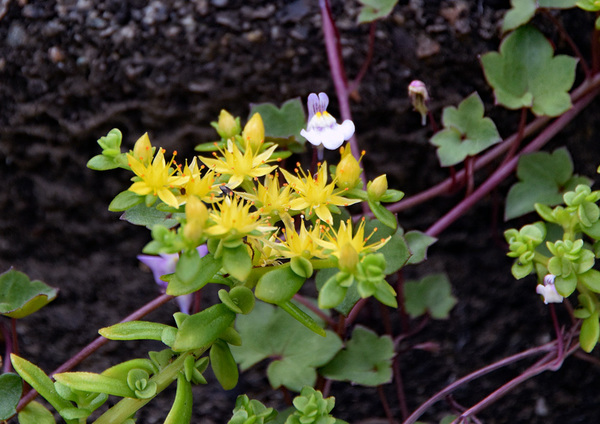
Japanese name: コモチマンネングサ(子持万年草) Scientific name:Sedum bulbiferum
[Overview]
A biennial found in fields, roadsides, and paddies before they are plowed.
It is a succulent.
The stem branches well at the base, creeps along the ground, roots at the nodes, and grows to 20–60 cm long.
The upper part of the stem rises upright.
The leaves are simple and alternate, lanceolate, 1–1.5 cm long and 0.2–0.4 cm wide, and fleshy.
Small bulbils form in the leaf axils.
The bulbils fall to the ground during the rainy season, overwinter as they are, and begin to grow the following spring.
Many small yellow, star-shaped flowers are borne in a cyme on the upper part of the stem.
Seeds are not usually produced.
[Notes]
The Japanese name includes "komochi" ("child-bearing") because bulbils form in the leaf axils.