
Plant Encyclopedia

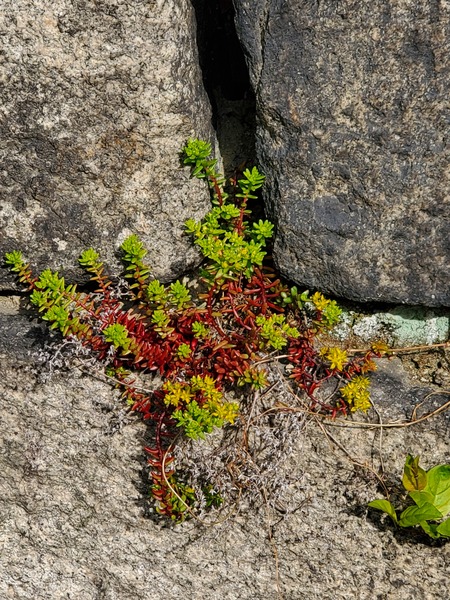
Sedum japonicum subsp. japonicum var. japonicum ("Menomannengusa")
Japanese name: メノマンネングサ (雌万年草)
Scientific name: Sedum japonicum subsp. japonicum var. japonicum
[Overview]
A perennial growing in sunny, dry places such as the backs of coastal sand dunes, cliffs, rocks and stone walls in low mountains, and thatched roofs.
The stems branch frequently and creep far along the ground, are often tinged with red, and the branches are erect or ascending.
The leaves are simple and alternate, rather sparse, often tending to gather in the upper part of the stem, cylindrical, fleshy, 0.5–1.8 cm long and 0.2–0.3 cm wide, sessile, with a very short spur about 0.5 mm long at the base.
The leaves on the lower part of the stem are often tinged with red.
A three-branched cyme arises at the stem tip; its branches are 1–3 cm long and rather densely bear yellow five-petaled flowers that open into a star shape about 1 cm across.
There are 10 stamens, and the anthers are deep yellow to orange-yellow.
The sepals have short spurs.
[Cultivation]
Propagate by division, shoot cuttings or seed.
It prefers sunny, well-drained soil.
For potted plants, water thoroughly when the soil surface dries in spring and autumn, place the pot where it is sheltered from rain and water sparingly in summer, and rainfall is sufficient in winter.
For plants in the ground, rainfall is sufficient.
Fertilize sparingly, applying a small amount of liquid fertilizer in spring and autumn.
There are no particular pests or diseases.
Details
Translated from our Japanese encyclopedia. If anything differs, the Japanese page is correct.