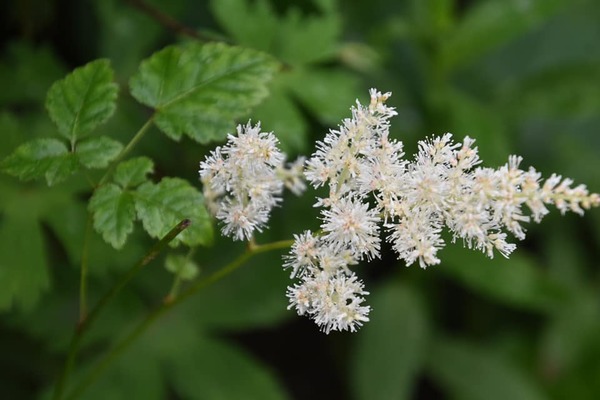
Japanese name: アカショウマ(赤升麻) Scientific name:Astilbe thunbergii var. thunbergii
[Overview]
A perennial 40–80 cm tall, found at forest edges and in bright woodland in the mountains.
It has a rhizome.
The leaves are of two kinds, basal leaves and stem leaves, both three times ternately compound.
The leaflets are elliptic to narrowly ovate, 4–10 cm long and 2–4.5 cm wide, not glossy, with irregular doubly serrate margins.
The flower stalk is often tinged with crimson at the base and bears a compound raceme at the tip.
The lower branches of the inflorescence are 6–9 cm long; except for the lowest, they are unbranched and densely covered with glandular hairs.
The flowers are white with 5 petals; the petals are spoon-shaped, 3 mm long, and longer than the stamens.
The fruit is a capsule 2–3 mm long.
[Uses]
The rhizome is used medicinally and as a bath additive.
[Cultivation]
Propagate by division or from seed.
It prefers partial shade and fertile, moderately moist, well-drained soil.
Direct summer sun can scorch the leaves, so a spot under deciduous trees is suitable.
Take care that it does not dry out, and water thoroughly when the soil surface dries.
In spring and autumn, apply slow-release fertilizer.
If drainage is poor and humidity builds up, southern blight and gray mold can occur.
[Notes]
The Japanese name comes from the reddish tinge of the rhizome.