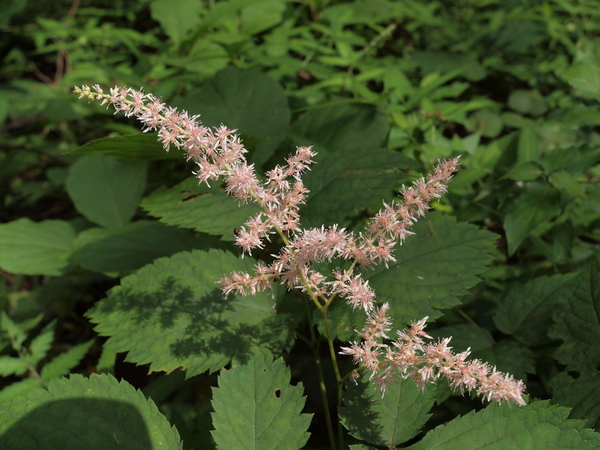
Astilbe microphylla var. microphylla("Chidakesashi")
Japanese name: チダケサシ(乳茸刺) Scientific name:Astilbe microphylla var. microphylla
[Overview]
A perennial 40–80 cm tall, growing at woodland edges and in moist grasslands.
It has a rhizome.
There are basal leaves and stem leaves, both two to four times odd-pinnately compound.
The leaflets are elliptic to obovate, 2–4 cm long and 1–2 cm wide, and the tip is not tail-like.
The leaf margins have sharp double serrations.
The tip of the flower stalk bears a compound raceme; its branches are ascending to nearly erect, and the lower ones are 3–5 cm long.
The flowers are pale pink with 5 petals; the petals are spoon-shaped, 3–5 mm long, and longer than the stamens.
The fruit is a capsule 3–4 mm long.
[Uses]
The rhizome is used medicinally and as a bath additive.
[Cultivation]
Propagate by division or from seed.
It prefers partial shade and fertile, well-drained soil with moderate moisture.
Direct summer sun can scorch the leaves, so a site under deciduous trees or similar is suitable.
Watch for dryness, and water thoroughly when the soil surface dries.
In spring and autumn, apply slow-release fertilizer.
If drainage is poor and humidity builds up, southern blight and gray mold may occur.
[Notes]
The Japanese name is said to derive from people skewering the mushroom called chichitake on the flower stalk and carrying it home.