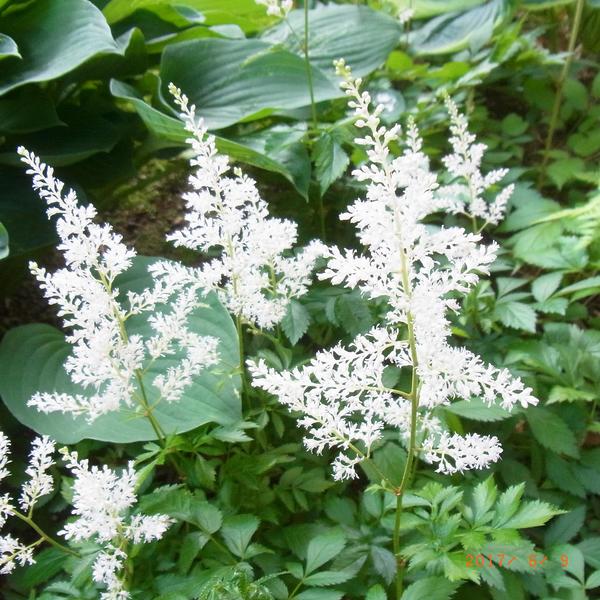
Japanese name: アワモリショウマ(泡盛升麻) Scientific name:Astilbe japonica
[Overview]
A perennial 50–80 cm tall, growing on rocky ground along valleys.
It has a rhizome.
Both the basal and stem leaves are two to three times ternately compound; the leaflets are oblong to lanceolate, 3–7 cm long and 1–2.3 cm wide, with a tail-like pointed tip and deeply doubly serrate margins.
The petiole is 5–15 cm.
The flower stalk bears 1–2 stem leaves.
The tip of the flower stalk bears a compound raceme-like to panicle-like inflorescence; its branches are ascending to nearly erect and densely covered with glandular hairs.
The flowers are white with 5 petals; the petals are spoon-shaped, 3–4 mm long and 1–1.5 mm wide.
The fruit is a capsule 3–4 mm long.
[Cultivation]
Propagate by division or from seed.
It prefers partial shade and fertile, well-drained soil with moderate moisture.
If drainage is poor and humidity builds up, southern blight and similar diseases may occur.
[Notes]
The Japanese name compares the way many small white flowers bloom in a cluster to foam.