
Plant Encyclopedia

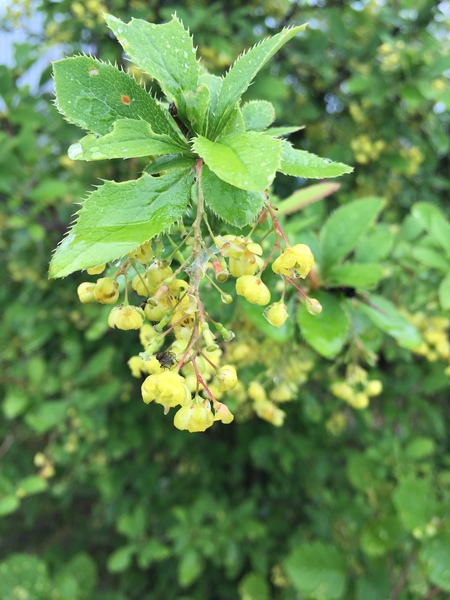
Berberis sieboldii ("Hebinoborazu")
Japanese name: ヘビノボラズ (蛇不登)
Scientific name: Berberis sieboldii
[Overview]
A deciduous shrub found on poor soil near wetlands in warm regions.
It is about 80 cm tall and much branched, with dark gray to grayish brown bark.
The ridges of the branches are indistinct.
At the nodes of the branches, three sharp spines 5–15 mm long, which are modified leaves, are conspicuous.
The leaves are simple, clustered on short shoots and alternate on long shoots, obovate to oblanceolate, 3–9 cm long and 1–2 cm wide.
The leaves are somewhat leathery and hairless on both sides; the underside is whitish, and the base gradually narrows into the petiole.
The leaf margin has fine teeth, the tips of which are bristle-like.
Young leaves often have a reddish-purple pattern.
Pendent racemes emerge at the tips of the short shoots and bear several flowers; the inflorescence is usually shorter than the leaves.
The flowers are deep yellow, 6-petaled, and 6 mm across.
The fruit is a berry, nearly spherical, 6 mm in diameter, and ripens red.
[Cultivation]
Propagate from seed or cuttings.
For seed, collect ripe fruit, wash off and remove the pulp, and sow immediately.
It is not particular about soil as long as the site is sunny and well drained.
It also grows in shade, but the branches and leaves become sparse.
It is hardy and easy to grow.
For potted plants, water thoroughly from spring to autumn when the soil surface dries.
For plants in the ground, watering is not particularly necessary unless the soil becomes extremely dry.
Fertilizer is hardly necessary, but if it has been pruned, apply slow-release fertilizer after flowering.
It has strong sprouting ability, so it is easy to shear into shape.
Pruning is best done in the dormant season in January–February or after flowering in May–June, but pruning in winter cuts off the flower buds, so it will not flower the following year.
There are no particular pests or diseases.
[Notes]
The Japanese name means that, because of its sharp spines, even snakes cannot climb this tree.
Details
Translated from our Japanese encyclopedia. If anything differs, the Japanese page is correct.