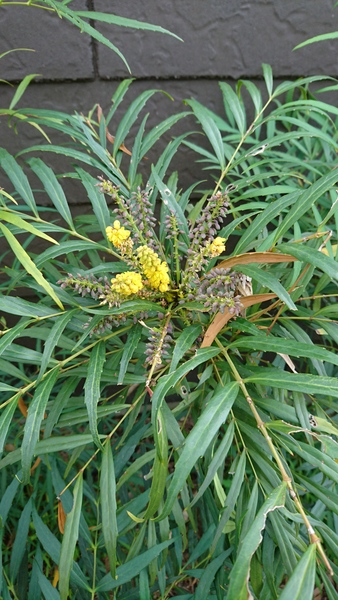
Japanese name: ナリヒラヒイラギナンテン(業平柊南天) Scientific name:Berberis eurybracteata
[Overview]
An evergreen shrub about 1–2 m tall.
The leaves are alternate, odd-pinnately compound, 20–40 cm long, and tend to cluster at the branch tips.
There are 5–10 pairs of leaflets, each 5–15 cm long, narrowly lanceolate to oblong, with a few spiny teeth.
The leaves take on a reddish tinge in winter.
Upright racemes are produced at the branch tips.
The flowers are pale yellow with 6 petals.
The fruit is a berry that ripens to blackish purple, and its skin is covered with a white waxy bloom.
[Cultivation]
Propagate from seed or by cuttings.
For seed, collect ripe fruits, wash off the pulp with water, and sow immediately.
It is suited to cultivation in the Tohoku region and south, and it is preferable to keep it out of cold winter winds.
It grows in sun to partial shade and is not particular about soil, but prefers fertile soil that does not become too dry.
In shade it becomes leggy and flowers poorly.
It is vigorous and easy to grow.
For potted plants, water thoroughly from spring to autumn when the soil surface dries.
For plants in the ground, watering is not particularly necessary unless the soil becomes extremely dry.
Apply slow-release fertilizer in winter.
If the branches become leggy, prune to tidy the shape.
There are no particular pests or diseases.
[Notes]
Because of a synonym of its scientific name, it is also called Mahonia Confusa.