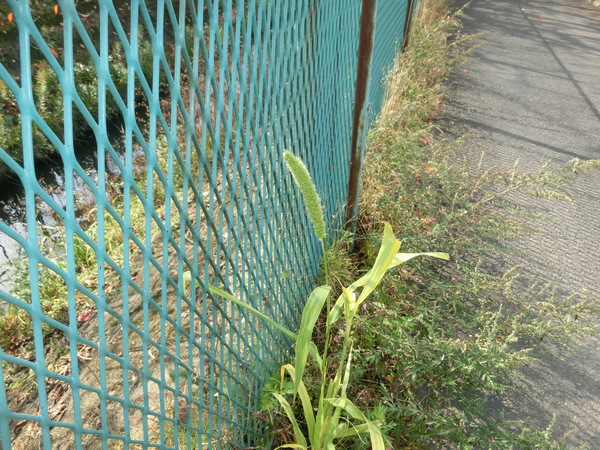
Japanese name: アワ(粟) Scientific name:Setaria italica
[Overview]
An annual 0.5–1.5 m tall.
The stem branches at the base and stands erect.
The leaves are linear, 20–45 cm long and 1–3.5 cm wide.
A cylindrical flower spike 8–25 cm long and 2–4 cm in diameter stands erect at the stem tip, or droops slightly at the tip.
The spike bears densely packed spikelets; the spikelets are almost spherical, about 0.3 cm in diameter, with 1–4 awn-like bristles at the base that project outside the spike.
The fruit usually ripens yellow, but depending on the variety may also be yellowish brown, red, brown, or black.
In ripe spikelets, only the florets fall off, leaving the glumes behind.
[History]
One of the five grains, it is thought to have originated in China and is regarded as a cultivated species developed from Enokorogusa.
[Uses]
It is used for food, fodder, and cut flowers.
[Cultivation]
Propagate from seed.
It grows well in any soil as long as the site is sunny.