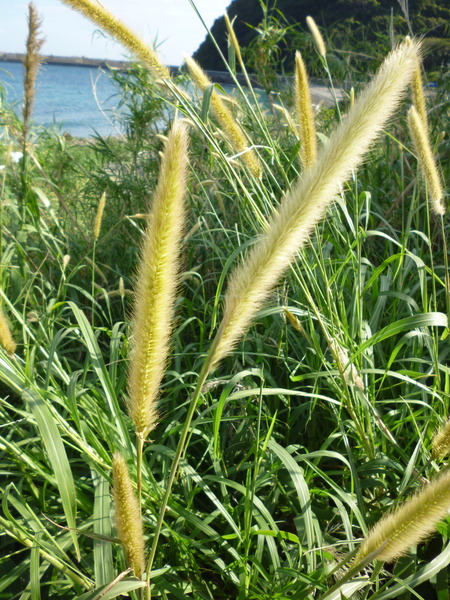
Japanese name: ナピアグラス Scientific name:Pennisetum purpureum
[Overview]
A large perennial 1–1.8 m tall; there are reports of it reaching 3 m overseas.
The stem (culm) is erect, or the lower part lies down and then rises, and it often branches in the upper part.
The leaves are simple and alternate, linear, 12–45 cm long and 0.4–1.5 cm wide (overseas, 60–90 cm long and 2–3 cm wide); the upper surface is at first covered with coarse hairs, later becoming hairless.
The leaf sheaths are somewhat flattened, and the ligule is a row of long soft hairs.
A slender cylindrical spike 8–16 cm long is borne at the branch tips, densely set with many spikelets.
The spikelets have 20–30 long pale yellowish-brown involucral bracts (awns) (overseas, some are tinged with purplish red), of which 2–3 bear long soft hairs and look feathery.
[History]
It was introduced for fodder to the warm regions south of Kyushu, and in 1991 Sumihiko Hatsushima reported it as naturalized on Yakushima and Tanegashima; it is commonly seen in the Ryukyu Islands.