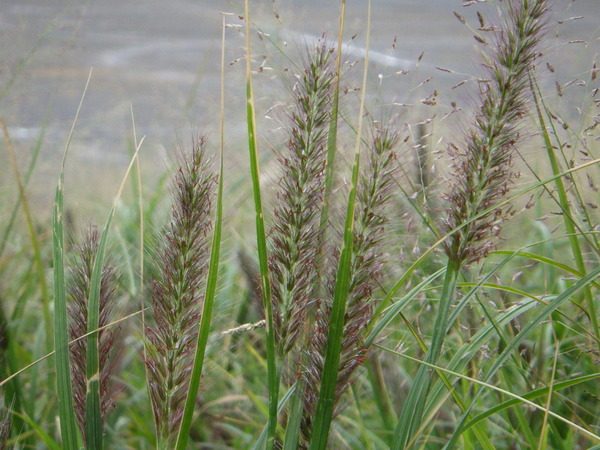
Japanese name: チカラシバ(力芝) Scientific name:Pennisetum alopecuroides
[Overview]
A perennial about 60–90 cm tall, found along roadsides and on vacant lots.
It forms large clumps.
The culms (stems) do not branch.
The leaves are linear, 10–45 cm long and 0.3–0.6 cm wide, and are produced in large numbers.
The leaf sheaths are flattened and keeled.
At the stem tip it produces a cylindrical flower spike 10–15 cm long and 4–5 cm across, densely set with many spikelets.
The spikelets have long bracts (awns), giving the flower spike the shape of a bottle-washing brush.
The flower spike is usually purple.
The spikelets are lanceolate, about 0.7 cm long; the second glume is about half the length of the spikelet and has distinct veins.
The fruit detaches together with the hairs at its tip and is carried away by animals and the like.
[Cultivation]
Propagate from seed.
It prefers a sunny, well-drained place.
It is hardy and easy to grow.
Rainfall is sufficient.
If basal fertilizer is applied, no further fertilizing is particularly necessary.
There are no particular pests or diseases.
[Notes]
The Japanese name derives from the fact that its roots grow strongly and it is hard to pull out even with force.