
Plant Encyclopedia

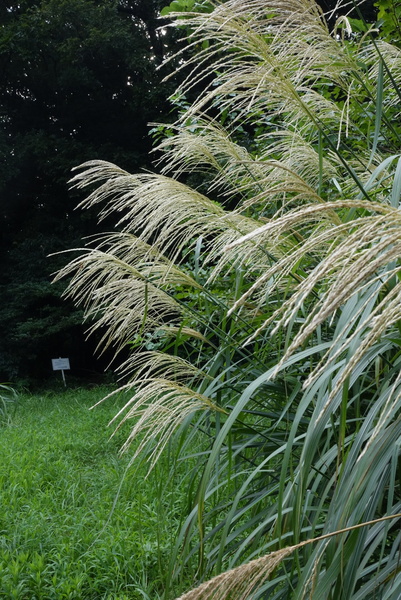
Miscanthus sinensis (eulalia, "Susuki")
Japanese name: ススキ (薄、芒)
Scientific name: Miscanthus sinensis
[Overview]
A perennial up to 2 m tall, commonly found in sunny places and often forming grasslands in colonies.
The underground stems are short and branch to form large clumps.
The stem is erect and hard.
The leaves are long and linear, with a conspicuous thick white midrib.
The leaf margins have sharp hooked prickles and are very rough, and may cut the hand.
At the stem tip it produces a large corymb-like inflorescence 20–30 cm long.
The inflorescence bears many slender branches leaning to one side.
These branches carry many spikelets 5–7 mm long, each consisting of 2 florets.
The base of the spikelet has white to pale purple hairs, so the whole flower spike looks silvery white.
The lemma has a long awn.
[Uses]
It is one of the Seven Herbs of Autumn.
The stems and leaves were used to thatch roofs, and were also used as material for brooms and charcoal bags.
It is offered at the Jugoya full-moon viewing.
There is also a custom of sticking the ears in the doorway to pray for a good harvest.
In Tokyo there is a local folk toy in which an owl is made from the ears.
[Notes]
There are several theories about the origin of the name, such as that it means "to grow vigorously (sukusuku)", or that susu, like sasa, means "slender".
[Cultivation]
Propagate by division or from seed.
In a sunny, well-drained place, there are no special points to watch.
There are no particular pests or diseases, but a spider called Kabaki-komachigumo rolls the leaves to make its nest.
If you open this nest, you may be bitten by the female inside.
A bite causes severe pain that lasts for several days.
It is regarded as a beneficial insect and need not be removed, but care is needed not to touch the nest.
Details
Japanese: ススキ(薄、芒)、カヤ(茅)、オバナ(尾花)
Translated from our Japanese encyclopedia. If anything differs, the Japanese page is correct.