
Plant Encyclopedia

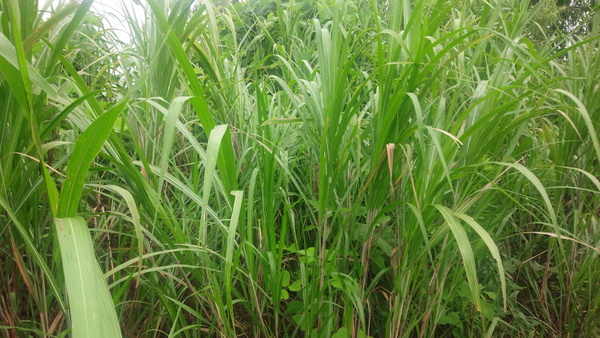
Miscanthus sacchariflorus (Amur silvergrass, "Ogi")
Japanese name: オギ (荻)
Scientific name: Miscanthus sacchariflorus
[Overview]
A perennial 1–2.5 m tall, growing in colonies in wet places such as waterside areas and riverbanks.
The underground stems are thick and extend far.
Unlike Susuki, it does not form clumps.
The culm (stem) is erect and hard, and measures 1–1.5 cm in diameter at the base.
The leaves are alternate, linear, 20–80 cm long, with rough margins.
At the stem tip it produces a large flower spike 25–40 cm long.
The flower spike bears many branches 20–40 cm long.
On these branches, many long-stalked and short-stalked spikelets grow in pairs.
The spikelets are 5–6 mm long and consist of 2 florets; the base has soft, silvery-white hairs 2–4 times as long as the spikelet, so the whole flower spike looks silvery white.
The lemma has no awn, or if it does, the awn hardly projects beyond the spikelet.
[Uses]
The stems and leaves were used to thatch roofs.
[Cultivation]
Propagate by division or from seed.
In a sunny, moist place, there are no special points to watch.
There are no particular pests or diseases, but a spider called Kabaki-komachigumo rolls the leaves to make its nest.
If you open this nest, you may be bitten by the female inside.
A bite causes severe pain that lasts for several days.
It is regarded as a beneficial insect and need not be removed, but care is needed not to touch the nest.
Details
Japanese: オギ(荻)
Translated from our Japanese encyclopedia. If anything differs, the Japanese page is correct.