
Plant Encyclopedia

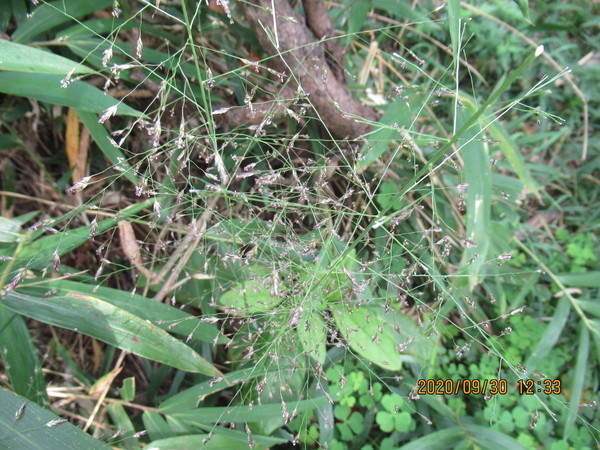
Eragrostis ferruginea ("Kazekusa")
Japanese name: カゼクサ (風草)
Scientific name: Eragrostis ferruginea
[Overview]
A perennial 30–80 cm tall, found in sunny places such as roadsides and vacant lots, often forming large colonies.
It produces no stolons; the stems grow in tufts, stand upright, and form a large clump.
Most leaves emerge from the base of the plant; they are linear, 20–40 cm long and 0.3–0.6 cm wide, hairless, powdery white on the upper surface and dark green on the underside, and the two surfaces are often reversed.
The leaf sheath is somewhat flattened with a keeled back, and long hairs grow densely at the top of the sheath and the base of the leaf.
A narrowly ovate spike 20–40 cm long emerges at the stem tip, bearing many spikelets sparsely.
The spikelet stalks have a ring-shaped yellow gland.
The spikelets are 6–10 mm long, flat, consisting of 5–10 florets, and are glossy and tinged with reddish purple.
When ripe, the caryopsis falls out of the lemma and other parts, leaving it exposed.
[Cultivation]
Propagate from seed.
It prefers a sunny, well-drained site and grows well even if left alone when the conditions suit it.
Rainfall is sufficient unless summer brings a long spell of sunny weather and the soil becomes severely dry.
Fertilizer is not particularly necessary.
There are no particular pests or diseases.
[Notes]
The Japanese name derives from its Chinese name, 知風草 (zhifengcao).
Details
Translated from our Japanese encyclopedia. If anything differs, the Japanese page is correct.