
Plant Encyclopedia

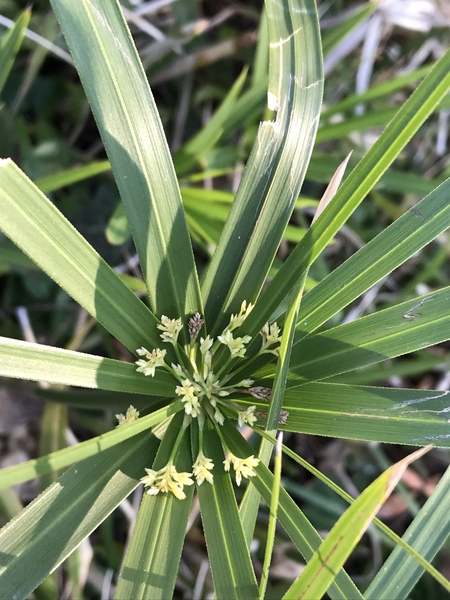
Cyperus alternifolius subsp. tlabelliformis (umbrella-plant, "Shurogayatsuri")
Japanese name: シュロガヤツリ (棕櫚蚊屋吊、棕櫚蚊帳釣)
Scientific name: Cyperus alternifolius subsp. tlabelliformis
[Overview]
A perennial that grows in wetlands and ponds and reaches over 1 m in height.
It has a short rhizome.
The stems grow in tufts and are bluntly triangular in cross section.
The leaf bases form sheaths that enclose the stem, and there are no leaf blades.
Several branches 2–5 cm long extend in an umbel-like arrangement from the stem tip, and 10–30 spikelets are densely clustered radially at the end of each branch.
At the base of the inflorescence, many slender, leaf-like bracts 10–30 cm long are arranged radially.
The spikelets are whitish green tinged with light brown, and are flat and oblong, about 0.5–0.8 cm long and 0.2 cm wide.
[History]
It arrived before 1937 and has become naturalized from the Kanto region westward.
[Uses]
The rhizome is used medicinally, for example applied externally for bites.
In tropical regions it is used as a material for mats and similar items.
[Cultivation]
Propagate from seed, by division, or by cuttings.
It can overwinter outdoors in areas without frost.
It prefers a sunny place that is always moist, and planting in paddy soil is suitable.
Take care not to let it dry out; for potted plants, the pot may be stood in water.
From spring to autumn, bury slow-release fertilizer or fermented oil cake in the soil.
There are no particular pests or diseases.
[Notes]
The Japanese name compares the shape of the bracts to the leaves of the shuro (hemp palm).
Details
Japanese: シュロガヤツリ(棕櫚蚊屋吊、棕櫚蚊帳釣)、カラカサガヤツリ(唐笠蚊屋吊、唐笠蚊帳釣)
Translated from our Japanese encyclopedia. If anything differs, the Japanese page is correct.