
Plant Encyclopedia

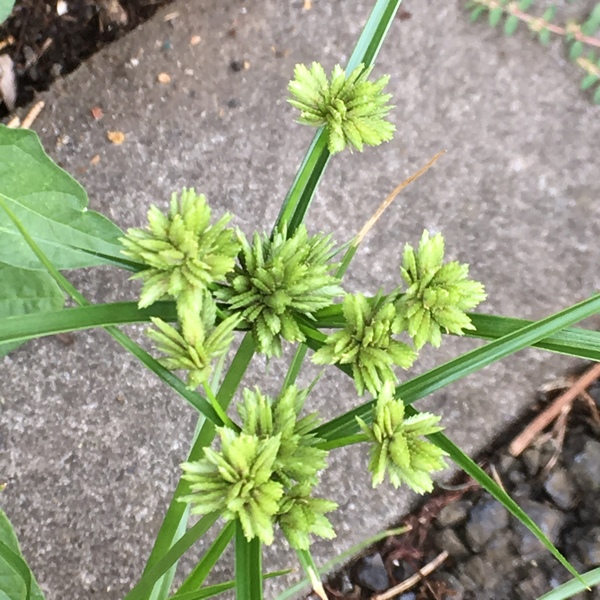
Cyperus eragrostis (tall flatsedge, "Merikengayatsuri")
Japanese name: メリケンガヤツリ
Scientific name: Cyperus eragrostis
[Overview]
A perennial 30–100 cm tall, growing in fields, ditches, and wetlands along riverbanks and pond edges.
It has a thick, short rhizome.
The stems grow in tufts and are bluntly triangular in cross section.
The leaves are linear, 0.4–0.8 cm wide, and about as long as the stem.
The leaf margins are rough, and the base forms a sheath that wraps around the stem.
At the base of the stem there is no leaf blade, and 2–3 reddish purple-tinged leaves are attached.
At the stem tip it extends 5–10 branches in an umbel-like arrangement, and 5–20 spikelets are densely clustered in a head at the branch tips.
4–7 long leaf-like bracts are attached at the base of the inflorescence.
The spikelets are pale yellowish green, flat and elliptical, about 0.5–2 cm long and 0.3 cm wide.
The fruit is about 0.1 cm long, obovate, with 3 ridges.
[History]
It is said to have arrived in Japan in the 1950s.
Details
Japanese: メリケンガヤツリ、オニシロガヤツリ
Translated from our Japanese encyclopedia. If anything differs, the Japanese page is correct.