
Plant Encyclopedia

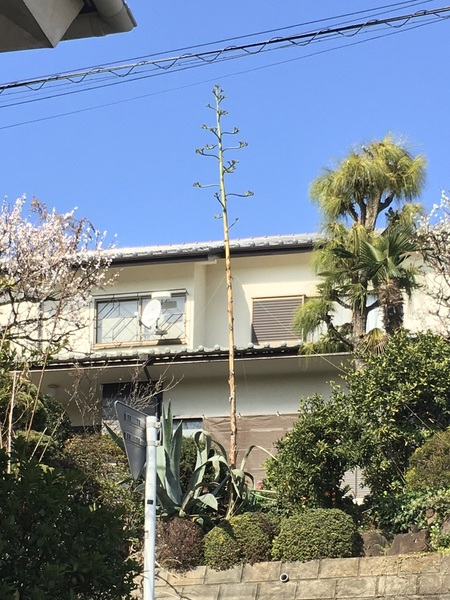
Agave americana (sentry plant, "Aonoryuzetsuran")
Japanese name: アオノリュウゼツラン (青竜舌蘭)
Scientific name: Agave americana
[Overview]
An evergreen succulent with a rosette up to 3–4 m across; it is a monocarpic plant that dies after flowering.
It has a very short stem, and the leaves are alternate in a rosette, long linear-lanceolate, 2 m long and 0.3 m wide, fleshy, with a white bloom on the surface and a bluish-green color.
There is a spine 3 cm long at the leaf tip, and spines about 1 cm long line the leaf margins.
In Japan it flowers after around 40 years, raising an erect flower stalk 5–10 m tall and 10 cm across that bears a panicle, with the flowers opening in order from the bottom.
The flowers are yellowish white, and the corolla is 6-lobed with tips that do not curl back.
There are 6 stamens, which protrude from the flower.
The fruit is a capsule.
[History]
A garden cultivar with variegated leaf margins was introduced first and was given the name Ryuzetsuran, so this green-leaved species that arrived later came to be called "Aono"-ryuzetsuran.
[Uses]
Fiber can be obtained from the leaves.
The young flower stalks are eaten, and the sap at this stage is used as a sweetener, for fermented liquor, and as medicine.
[Cultivation]
Propagate from seed, from bulbils formed on the inflorescence, or from offsets formed at the base of the rosette.
It can overwinter outdoors in areas without frost.
It prefers a sunny, well-drained, well-ventilated place.
It grows large and needs plenty of space.
It is better kept on the dry side, so rainfall is sufficient.
Apply slow-release fertilizer placed on the soil from spring to autumn.
When the lower leaves die, cut them off at the base.
Pests and diseases include spider mites and scale insects.
Details
Japanese: アオノリュウゼツラン(青竜舌蘭)
Translated from our Japanese encyclopedia. If anything differs, the Japanese page is correct.