
Plant Encyclopedia

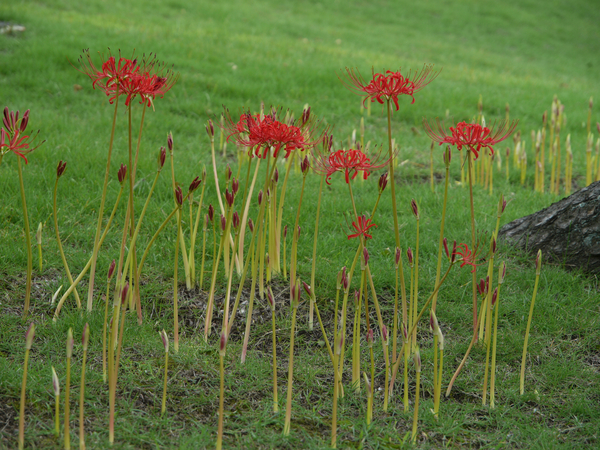
Lycoris radiata var. radiata (hurricane lily, "Higanbana")
Japanese name: ヒガンバナ (彼岸花)
Scientific name: Lycoris radiata var. radiata
[Overview]
A perennial 30–60 cm tall, growing in colonies along roadsides, on rice paddy banks, in graveyards and similar places.
It has a poisonous, broadly ovate underground bulb.
The leaves are basal, linear, glossy dark green, 30–40 cm long and 0.6–0.8 cm wide.
The leaves appear after flowering, overwinter, die back around March–April, and the plant is dormant during the summer.
A cylindrical flower stalk 30–60 cm tall grows from the bulb and bears an umbel at its tip, with several flowers arranged radially.
The flowers are vermilion-red, funnel-shaped, with 6 petals, and the tepals are lanceolate and strongly recurved.
The stamens and pistil protrude long.
The fruit is a capsule; seeds are scarcely produced, and even when they are, they often do not germinate.
[History]
It is thought to be a prehistoric naturalized plant that came from China in ancient times.
[Uses]
The bulb is poisonous but is used medicinally.
In times of famine, it was also soaked in water many times to remove the poison, and the starch was extracted and eaten.
[Cultivation]
Propagate by dividing the bulbs.
It can be left planted for several years without problem.
It prefers sunny, well-drained soil that retains moisture and is well aerated.
It dislikes excess moisture.
During leafless dormancy it does better in shade and on the dry side, so for plants in the ground it is good to plant them under deciduous trees or among summer grasses.
For potted plants, from the time the flower stalks emerge until before dormancy, water thoroughly when the soil surface dries; during dormancy, water only enough to keep the soil from drying out completely.
For plants in the ground, rainfall is sufficient.
After flowering, apply a fertilizer high in phosphorus and potassium.
When the flowers are over, snap them off at the flower neck.
There are no particular pests or diseases, but soft rot may occur if the soil is too wet.
[Notes]
The Japanese name comes from the fact that it blooms around the autumn higan (equinox week).
It has a great many other names.
Details
Japanese: ヒガンバナ(彼岸花)、曼珠沙華
Translated from our Japanese encyclopedia. If anything differs, the Japanese page is correct.