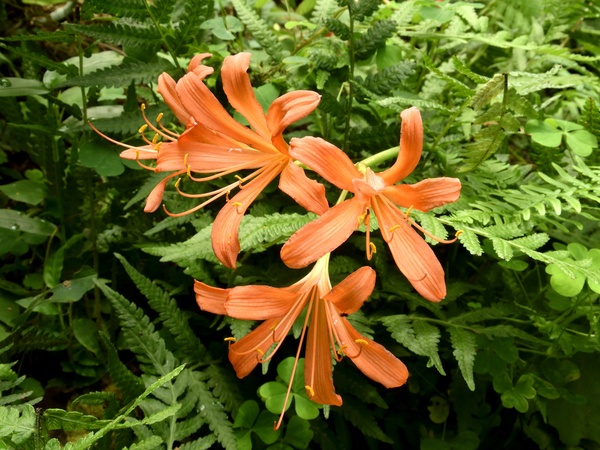
Lycoris sanguinea var. sanguinea("Kitsunenokamisori")
Japanese name: キツネノカミソリ(狐剃刀) Scientific name:Lycoris sanguinea var. sanguinea
[Overview]
A perennial 30–50 cm tall, found along roadsides and at woodland edges.
It has a broadly ovate underground bulb 2–4 cm across.
The outer skin of the bulb is blackish brown.
The leaves are basal, rather broad and linear, 30–40 cm long and 0.8–1 cm wide.
The leaves appear in spring and die back in summer.
After the leaves have died back, the flower stalk rises.
The tip of the flower stalk bears 3–5 yellowish red flowers in an umbel-like cluster.
The flowers have 6 petals, are 5–8 cm long, and open obliquely.
The tips of the tepals are not recurved.
The fruit is a spherical capsule 1.5 cm across, and fruit sets well.
The seeds are round, flat, and black.
[Notes]
The Japanese name is said to come from the plant growing in lonely places where foxes might appear, and from its leaves resembling a razor.
It is a poisonous plant.