
Plant Encyclopedia

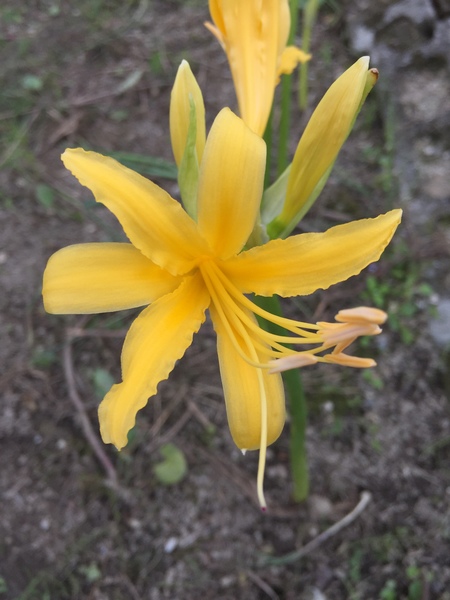
Lycoris traubii (golden spider lily, "Shokizuisen")
Japanese name: ショウキズイセン (鍾馗水仙)
Scientific name: Lycoris traubii
[Overview]
A perennial up to 50 cm tall, found in damp places in hills and fields in warm regions.
It has a poisonous, broadly ovate bulb underground.
The leaves are basal, linear, 20–60 cm long and 1.5–3 cm wide, and glossy yellow-green to green.
The leaves emerge in late autumn, overwinter, die back before summer, and the plant is dormant through the summer.
A cylindrical flower stalk 50 cm tall rises from the bulb and bears an umbel at its tip, with several flowers arranged radially.
The flowers are funnel-shaped with 6 tepals, bright yellow to orange-yellow; the tepals are oblanceolate, recurved, and have wavy margins.
The stamens and pistil are almost the same color as the tepals and protrude far out of the flower.
The fruit is a cylindrical capsule 1 cm across, and the seeds are spherical, about 0.7 cm across, and glossy black.
[Uses]
The bulb is poisonous but is used medicinally.
[Cultivation]
Propagate by dividing the bulbs.
It can be left planted for several years.
It prefers sunny soil that is well drained, moisture-retentive and well aerated.
It dislikes excess moisture.
During dormancy, when it has no leaves, it does better in shade and on the dry side, so when planting in the ground, plant it under deciduous trees or among summer grasses.
For potted plants, water thoroughly when the soil surface dries from the time the flower stalks emerge until dormancy, and during dormancy water only enough that the soil does not dry out completely.
For plants in the ground, rainfall is sufficient.
Apply a fertilizer high in phosphorus and potassium after flowering.
When flowering is over, snap off the flower stalk at the neck of the flower.
There are no particular pests or diseases, but soft rot can appear if the soil becomes too wet.
Details
Japanese: ショウキズイセン(鍾馗水仙)、ショウキラン(鍾馗蘭)
Translated from our Japanese encyclopedia. If anything differs, the Japanese page is correct.