
Plant Encyclopedia

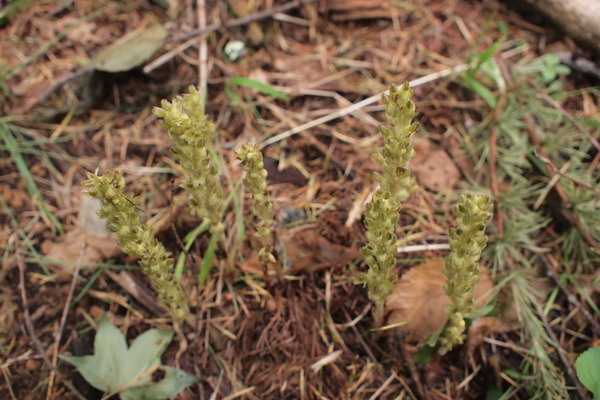
Neottia furusei ("Kaisakaneran")
Japanese name: カイサカネラン (甲斐逆根蘭)
Scientific name: Neottia furusei
[Overview]
A mycoheterotrophic plant 20–40 cm tall, found in deciduous forests in the subarctic to cool-temperate zones.
The rhizome stands upright in the ground and produces many roots whose tips point upward.
The whole plant is tinged with green.
The stem is thick and fleshy.
The leaves are degenerate, and membranous sheath-like leaves are borne alternately.
A raceme densely bears small pale green flowers.
The flowers face upward, and the sepals and lateral petals are almost the same in shape and length.
The tip of the lip is 2-lobed.
Bracts almost as long as the flowers are present.
Short white hairs grow densely on the inflorescence and ovary.
The fruit is a capsule.
[Notes]
The Japanese name contains 'Sakane', which comes from the upward-pointing roots, and 'Kai', which comes from its discovery in Yamanashi in 1948.
Details
Translated from our Japanese encyclopedia. If anything differs, the Japanese page is correct.