
Plant Encyclopedia

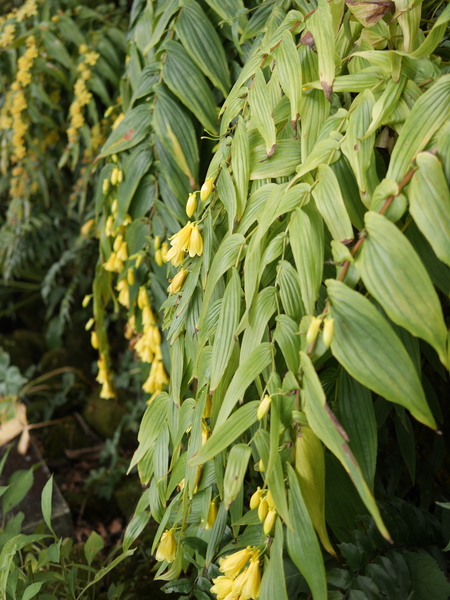
Tricyrtis macranthopsis ("Kiijorohototogisu")
Japanese name: キイジョウロウホトトギス (紀伊上臈杜鵑草)
Scientific name: Tricyrtis macranthopsis
[Overview]
A perennial that grows hanging down from moist cliffs in partial shade in the mountains.
It has a short underground stem.
The stem is zigzag, grows 40–80 cm long, and is almost hairless.
The leaves are simple and alternate, oblong, with a tail-like pointed tip.
The upper surface of the leaf is glossy and the underside is hairy.
The leaf base is ear-shaped and deeply clasps the stem.
The flowers are borne singly in the leaf axils in the upper part of the stem, with 1–2 more at the stem tip, and open facing downward.
The flowers are glossy, bright yellow, with 6 tepals, and are half-open and bell-shaped, about 4 cm long.
The inside of the flower is spotted with purplish brown all over.
The bases of the tepals form short spurs.
The style of the pistil is divided into 3 parts, each of which is further divided into 2 lobes and opens flat.
There are 6 stamens; the filaments rise along the styles and curve back at the top, bearing the anthers facing outward.
The fruit is a capsule.
[Cultivation]
Propagate from seed, by division, or by shoot cuttings.
It prefers a bright, partially shaded, moist place with good drainage, water retention and ventilation, and soil rich in humus.
It prefers high humidity in the air, so avoid places that dry out easily.
For potted plants, water thoroughly when the soil surface dries; for plants in the ground, rainfall is sufficient unless summer brings a long spell of sunny weather and the soil becomes severely dry.
If a slow-release fertilizer rich in phosphorus is applied as a base fertilizer, no further feeding is particularly necessary, but for potted plants, slow-release fertilizer may be placed on the soil once a month in spring.
Pests and diseases include southern blight and slugs.
Details
Translated from our Japanese encyclopedia. If anything differs, the Japanese page is correct.