
Plant Encyclopedia

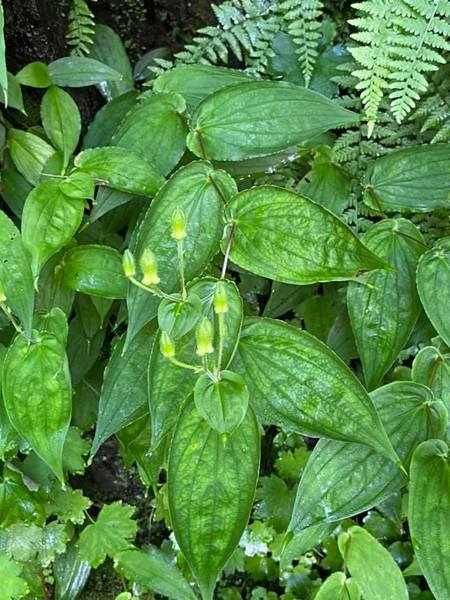
Tricyrtis latifolia var. latifolia ("Tamagawahototogisu")
Japanese name: タマガワホトトギス (玉川杜鵑草)
Scientific name: Tricyrtis latifolia var. latifolia
[Overview]
A perennial 40–80 cm tall, growing in slightly moist places such as forests along mountain streams and beside mountain torrents.
Leaves are simple and alternate, broadly oblong, 8–18 cm long, with pointed tips and almost hairless.
The leaf base clasps the stem.
Flowers are borne facing upward in corymbs arising at the stem tips and from the upper leaf axils, and the inflorescence has glandular hairs.
The flowers are cup-shaped with six tepals, about 2.5 cm across; the tepals spread obliquely and are yellow, and the bases of the outer tepals form pouch-like spurs.
The inside of the flower has purple-brown spots.
The style of the pistil divides into three, and each branch divides again into two and spreads out flat.
There are 6 stamens; the filaments rise along the style, curve back at the top, and bear the anthers facing outward.
The fruit is a capsule.
[Cultivation]
Propagate from seed, by division, or by shoot cuttings.
It prefers bright partial shade and a moist place rich in humus, with good drainage, water retention and aeration.
It prefers an environment with high air humidity, and places that dry out easily should be avoided.
For potted plants, water thoroughly when the soil surface dries; for plants in the ground, rainfall is sufficient unless summer brings a long spell of sunny weather and the soil becomes severely dry.
If a slow-release fertilizer rich in phosphorus is applied as a base fertilizer, nothing more is particularly needed, but for potted plants slow-release fertilizer may be placed on the soil once a month in spring.
Pests and diseases include southern blight and slugs.
[Notes]
The Japanese name is said to have been given after Tamagawa in Kyoto, a famous place for Yamabuki, because the color of the flower recalls Yamabuki.
Details
Translated from our Japanese encyclopedia. If anything differs, the Japanese page is correct.