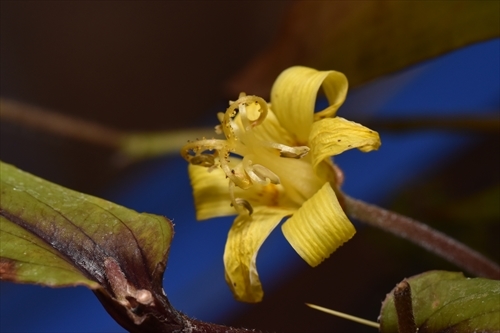
Japanese name: キバナノホトトギス(黄花杜鵑草) Scientific name:Tricyrtis flava subsp. flava
[Overview]
A perennial 20–50 cm tall.
The stem is sparsely hairy.
Leaves are simple and alternate, oblong-lanceolate and 8–20 cm long, with the base clasping the stem.
The leaves usually have no markings.
One or two flowers are borne facing upward in the leaf axils.
The flowers are cup-shaped with six tepals; the tepals spread flat and are yellow with purple-brown spots on the inside.
The outer tepals have brown hairs and swollen bases.
The style of the pistil divides into three, and each branch divides again into two and spreads out flat.
There are 6 stamens; the filaments rise along the style, curve back at the top, and bear the anthers facing outward.
The flower stalk is 2–6 cm long and densely covered with brown hairs.
The fruit is a capsule.
[Cultivation]
Propagate from seed, by division, or by shoot cuttings.
It prefers bright partial shade and well-drained soil.
It prefers an environment with high air humidity, and places that dry out easily should be avoided.
Water thoroughly when the soil surface dries.
As a base fertilizer, apply a slow-release fertilizer rich in phosphorus; in addition, slow-release fertilizer may be placed on the soil once a month in spring.
Pests and diseases include southern blight and slugs.