
Plant Encyclopedia

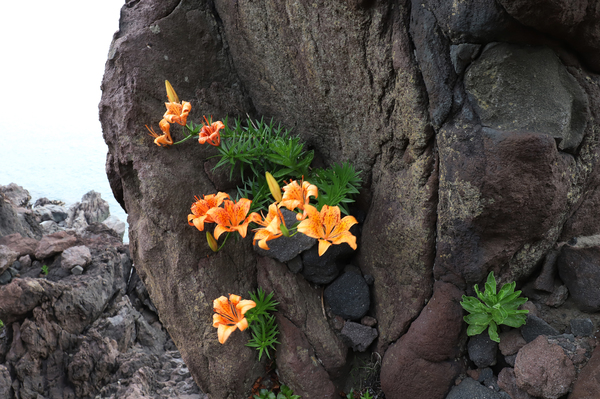
Lilium maculatum var. maculatum ("Sukashiyuri")
Japanese name: スカシユリ (透百合)
Scientific name: Lilium maculatum var. maculatum
[Overview]
A perennial 20–60 cm tall.
It is found on seaside sandy beaches, rocky places and similar sites.
Underground it has an ovoid, fleshy, white bulb.
The stem is ridged, and the lower part has papillate projections.
Young stems have some white woolly hairs.
Leaves are simple and alternate, lanceolate, 4–10 cm long, with entire margins.
The leaf surface is glossy.
The leaves have no stalk.
A raceme at the top of the stem bears one to several upward-facing flowers.
The flowers are cup-shaped.
The tepals are 7–10 cm long and orange-red, with reddish-brown spots on the inner surface and dense hairs along the central vein on the inside.
There are gaps between the tepals.
The stamens are shorter than the pistil, and the pollen is reddish brown.
The fruit is an obovate-elliptic capsule 4–5 cm long.
[Uses]
It is one of the important parents of the Asiatic hybrids.
[Cultivation]
Propagate from seed or by scale cuttings.
It prefers sunny, well-drained soil rich in humus.
Avoid excess moisture, and ensure good drainage and ventilation.
Protect it from cold wind in winter.
For potted plants, water when the soil surface dries; for plants in the ground, watering is unnecessary unless the soil becomes severely dry.
As a base fertilizer, apply a slow-release fertilizer mainly of phosphate and potash, and from spring until flowering apply a top dressing with equal parts nitrogen, phosphate and potash.
Pests and diseases include virus disease, rot and aphids.
[Notes]
The Japanese name comes from the fact that there are gaps between the tepals.
Details
Translated from our Japanese encyclopedia. If anything differs, the Japanese page is correct.