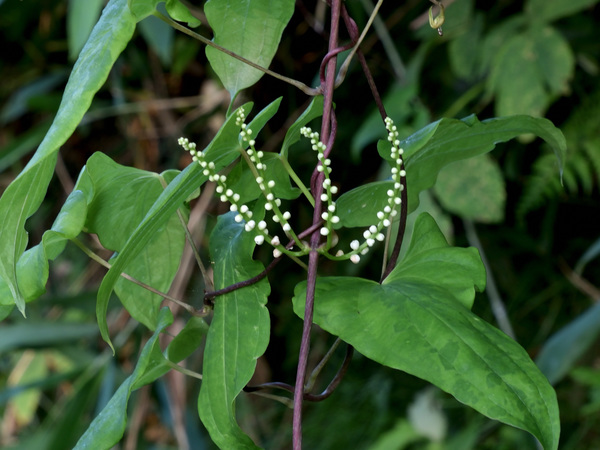
Japanese name: ヤマノイモ(山芋) Scientific name:Dioscorea japonica
[Overview]
A climbing perennial found in hills and fields.
The underground stem is cylindrical and extends deep into the ground.
The vine branches freely in the upper part.
Leaves are simple and alternate, triangular-lanceolate, 5–10 cm long and 3–5 cm wide, with a pointed tip and a heart-shaped base.
The leaf margin is entire.
The petiole is 4–6 cm long, thickened at the base, and bears bulbils about 1 cm across.
It is dioecious.
Male inflorescences stand erect, 2–5 from the leaf axils.
Female inflorescences hang down.
Both male and female flowers are white, with 6 tepals that do not open flat.
The fruit is an elliptic capsule 1.2–1.5 cm long and 2.5–3 cm wide, with 3 wings.
The seeds are flat and round, about 5 mm across, with a wing around them.
[Uses]
The tuber is made into dishes such as tororo-jiru (grated yam soup), and the bulbils are used in dishes such as rice cooked with other ingredients.
[Cultivation]
Propagate from seed tubers.
The roots extend deep into the soil, so deep tilling is necessary.