
Plant Encyclopedia

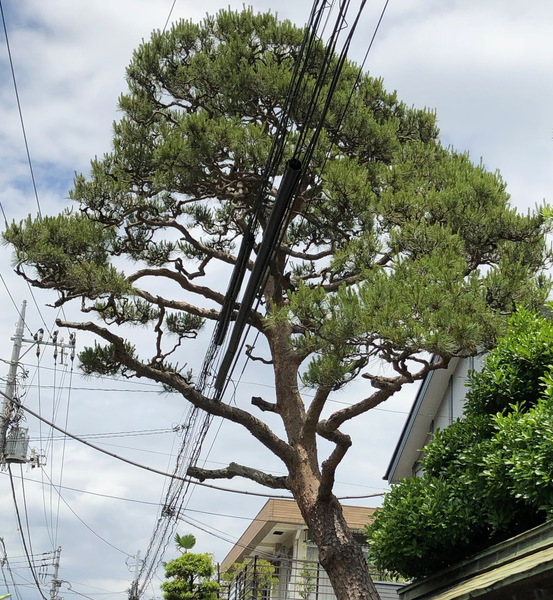
Pinus thunbergii (Japanese black pine, "Kuromatsu")
Japanese name: クロマツ (黒松)
Scientific name: Pinus thunbergii
[Overview]
An evergreen coniferous tree common along coasts, reaching 40 m in height and 3 m in trunk diameter.
The bark is blackish and cracks into a tortoiseshell pattern in old trees.
The leaves are needle-shaped, stiff, 10–15 cm long, borne in bundles of two, and semicircular in cross section.
Both male and female flowers are borne on new branches.
The male flowers are borne in large numbers toward the base of the branch, and the female flowers are small, purplish-red, pine-cone-shaped structures borne at the branch tip.
The cones are ovoid, 4–6 cm long and 3–3.5 cm across, and ripen in autumn of the following year.
The seeds have wings.
[Uses]
It is used as building timber.
[Cultivation]
Propagate from seed.
Its planting range extends from Aomori to Okinawa, and it can be planted even in Sapporo, but in Hokkaido it sometimes suffers cold damage.
Mountainous areas of the Tohoku region are also unsuitable.
It prefers a sunny, well-drained site.
Its roots host symbiotic fungi that need oxygen, so aerated soil is necessary.
It tolerates poor soil and dryness well, and trees grown from young plants send roots down deeply and become highly wind-resistant.
It dislikes transplanting when mature, and a transplanted tree often weakens and does not recover, so it is better to plant young trees whenever possible.
Water thoroughly when the soil dries.
Apply slow-release fertilizer around the plant as fertilizer in winter.
Pruning is kept to a minimum; the shape is maintained by 'midori-tsumi', pinching off the soft new shoots that grow in spring in April–May, and 'momiage', in late autumn leaving a few of the branches that grew in summer and stripping off the old leaves and remaining branches.
[Notes]
The name comes from the blackish color of the trunk.
Details
Japanese: クロマツ(黒松)、オマツ(男松)
Translated from our Japanese encyclopedia. If anything differs, the Japanese page is correct.