
Plant Encyclopedia

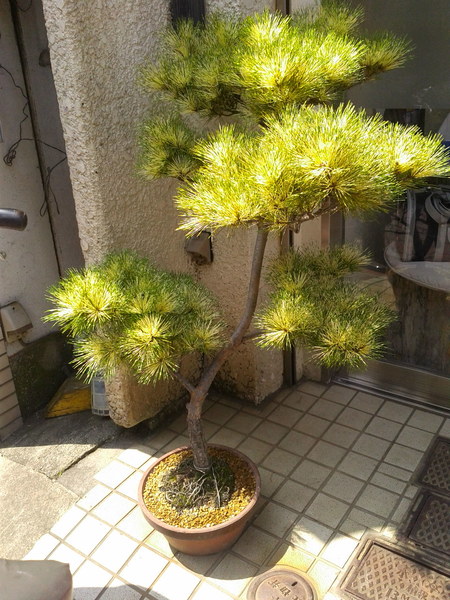
Pinus densiflora (Japanese red pine, "Akamatsu")
Japanese name: アカマツ (赤松)
Scientific name: Pinus densiflora
[Overview]
An evergreen coniferous tree reaching 30 m in height and 1.5 m in trunk diameter.
It is the first to colonize poor sites where other trees cannot grow, such as extremely dry places like rocky ground and lava flows, and wetlands.
The bark is reddish and cracks into a tortoiseshell pattern as the tree grows.
The leaves are needle-shaped, 7–10 cm long, borne in bundles of two, bright green, and semicircular in cross section.
Both male and female flowers are borne on new branches.
The male flowers are borne in large numbers toward the base of the branch, and the female flowers are small, reddish-purple, pine-cone-shaped structures borne at the branch tip.
The cones are ovoid, 4–5 cm long and 3 cm across, and ripen in autumn of the following year.
The seeds have wings.
[Uses]
Matsutake mushrooms grow in Akamatsu forests.
It is used as building timber and charcoal material, and the bark is used as a dye.
[Cultivation]
Propagate from seed.
It has the widest distribution of any Japanese pine and can withstand fairly cold climates; it can be planted south of Sapporo, but in Hokkaido it sometimes suffers cold damage.
It prefers a sunny, well-drained site.
Its roots host symbiotic fungi that need oxygen, so aerated soil is necessary.
It tolerates poor soil and dryness well, and extends its roots even in hard soil.
It dislikes transplanting when mature, and a transplanted tree often weakens and does not recover, so it is better to plant young trees whenever possible.
Water thoroughly when the soil dries.
Apply slow-release fertilizer around the plant as fertilizer in winter.
Pruning is kept to a minimum; the shape is maintained by 'midori-tsumi', pinching off the soft new shoots that grow in spring in April–May, and 'momiage', in late autumn leaving a few of the branches that grew in summer and stripping off the old leaves and remaining branches.
Its vigor recovers more slowly than Kuromatsu, so avoid heavy pruning and excessive leaf removal.
Care is needed against damage by the pine wood nematode.
[Notes]
The name comes from its reddish-brown trunk.
The alternative name Mematsu (female pine) refers to its being softer than Kuromatsu (male pine).
Details
Japanese: アカマツ(赤松)、メマツ(女松)、ミツバアカマツ(三葉赤松)
Translated from our Japanese encyclopedia. If anything differs, the Japanese page is correct.