
Plant Encyclopedia

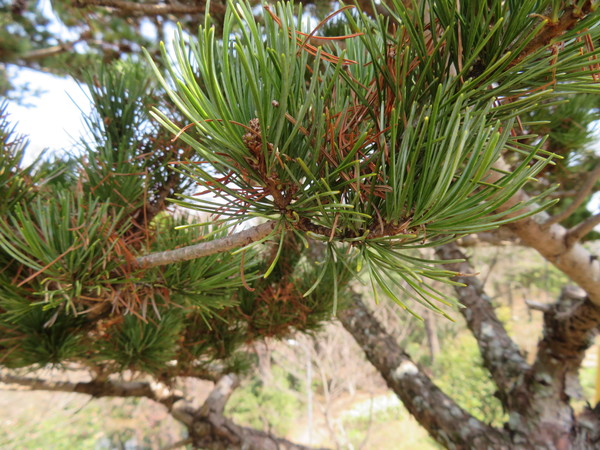
Pinus parviflora var. parviflora (five-needle pine, "Himekomatsu")
Japanese name: ヒメコマツ (姫小松)
Scientific name: Pinus parviflora var. parviflora
[Overview]
An evergreen coniferous tree reaching 30 m in height and 1 m in trunk diameter.
The bark is dark gray and peels in thin, irregular scales.
The leaves are needle-shaped, 3–6 cm long, borne in bundles of five, and slightly twisted.
The leaf is triangular in cross section, with white stomatal bands on two faces.
Both male and female flowers are borne on new branches.
The male flowers are borne in large numbers toward the base of the branch, and the female flowers are small pine-cone-shaped structures borne at the branch tip.
The cones are ovoid-oblong, 5–8 cm long and 3.5 cm across, and ripen in autumn of the following year.
The seeds have short, easily broken wings.
[Uses]
It is used as building timber and for furniture and fittings.
It is widely used as bonsai.
[Cultivation]
Propagate from seed or by grafting.
It prefers a sunny, well-drained site.
Its roots host symbiotic fungi that need oxygen, so aerated soil is necessary.
It tolerates poor soil and dryness well.
It dislikes transplanting when mature, and a transplanted tree often weakens and does not recover, so it is better to plant young trees whenever possible.
Water thoroughly when the soil dries.
Apply slow-release fertilizer around the plant as fertilizer in winter.
Pruning is kept to a minimum; the shape is maintained by 'midori-tsumi', pinching off the soft new shoots that grow in spring in April–May, and 'momiage', in late autumn leaving a few of the branches that grew in summer and stripping off the old leaves and remaining branches.
Details
Japanese: ヒメコマツ(姫小松)、ゴヨウマツ(五葉松)、マルミゴヨウ(丸実五葉)
Translated from our Japanese encyclopedia. If anything differs, the Japanese page is correct.