
Plant Encyclopedia

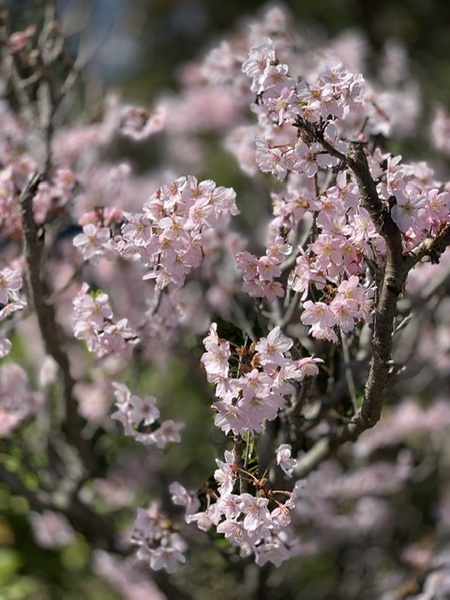
Cerasus ‘Takenakae’
Japanese name: 東海桜
Scientific name: Cerasus ‘Takenakae’
[Overview]
A cultivar produced by crossing Shinami-zakura and Kohigan-zakura.
A small deciduous tree.
The bark is pale grayish brown.
The branches grow upward, giving a broom-shaped crown.
Aerial roots often emerge from the branching points of the trunk.
The leaves are alternate and simple, oblong, 3–9 cm long and 1.5–4 cm wide, with long tail-like tips.
The upper surface of the leaf is dark green and strongly glossy, with sunken veins and hairs on the midrib, and the underside is slightly whitish and almost hairless.
The leaf margins have a mixture of fine double serrations and serrations, with glands at the tips of the teeth.
Nectaries are located at the upper end of the leaf stalk or at the base of the leaf.
It flowers before the leaves emerge.
The flowers are borne 2–3 at a time in corymbs arising from the leaf axils; they are 5-petaled, about 3 cm across, pale pink, and the petals are oblong to oblong-ovate, 1.2 cm long, slightly darker in color at the tip, with the tip split in two.
The calyx tube is bell-shaped, slightly urn-like, with hairs on the upper part and the base.
The calyx lobes are ovate-triangular with a few serrations only at the base, abundantly ciliate along the margins, and hairy on the outer surface as well.
The pedicels are hairy.
It differs in tree shape from Keio-zakura; Tokai-zakura is broom-shaped, while Keio-zakura is globe-shaped, which distinguishes them.
[History]
It was selected from Keio-zakura seedlings in Takarazuka, Hyogo and sold under the name Keiou-zakura, causing confusion of names with Keio-zakura.
[Cultivation]
Propagate by cuttings or grafting.
It prefers a sunny, well-drained place.
If it becomes troublesomely large when planted in a garden, it is good to limit the space for the roots to spread with a fabric pot in order to control the size of the tree.
While it is a young tree, protect it from frost by, for example, laying straw around its base.
Also, it is better not to cut the branches needlessly if there is no need.
It is prone to many pests and diseases, so caution is needed.
Details
Translated from our Japanese encyclopedia. If anything differs, the Japanese page is correct.