
Plant Encyclopedia

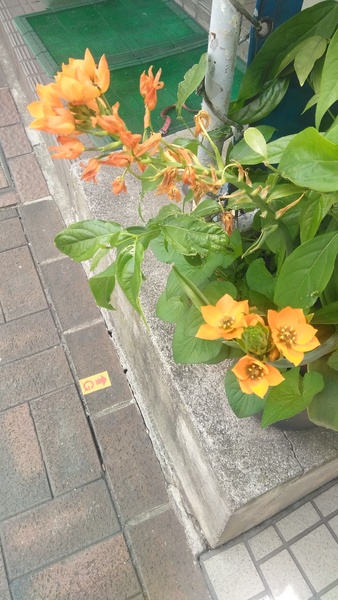
Ornithogalum dubium (sun star)
Japanese name: オーニソガラム ダビウム
Scientific name: Ornithogalum dubium
[Overview]
A perennial about 20–50 cm tall.
It has an egg-shaped bulb, which is poisonous.
Three to eight leaves form a basal rosette; they are broadly linear to linear-lanceolate, about 5–20 cm long and 0.5–3 cm wide, thick, with fine hairs on the margins.
The leaves wither after flowering, and the plant is dormant in summer.
A raceme at the tip of a flower stalk about 20–50 cm tall bears 5–25 flowers.
The flowers are 2.5 cm across and orange to yellow, with 6 tepals and a brown to dark green center.
The pistil is dark brown to green, thick and short.
The fruit is a capsule.
[Uses]
Although poisonous, it is used as a folk medicine in its native range.
[Cultivation]
Propagate by dividing the bulbs.
It can overwinter outdoors in regions without frost.
In other regions, grow it in a pot and bring it indoors in winter.
It prefers sandy soil that is sunny, well drained, water-retentive and well aerated.
It dislikes excess moisture.
Take care that the soil does not become waterlogged; for potted plants, water thoroughly when the soil dries during the growing period, and for plants in the ground, rainfall is sufficient.
When the leaves begin to wither, stop watering and either dig up the bulbs or put the pot in a place out of the rain and let it go dormant.
Apply compost as base fertilizer, and if the plant is left in the ground, apply a small amount of compost during the growing period.
There are no particular pests or diseases, but soft rot may occur if the soil becomes too wet.
Details
Japanese: オーニソガラム ダビウム
Translated from our Japanese encyclopedia. If anything differs, the Japanese page is correct.