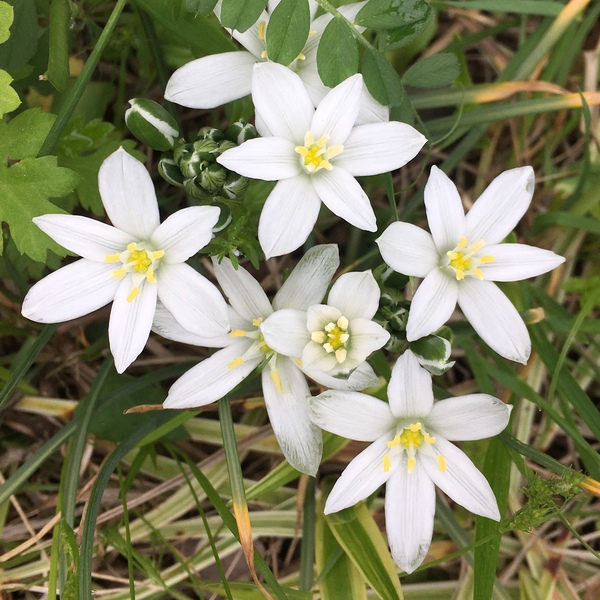
Japanese name: ホソバオオアマナ(細葉大甘菜) Scientific name:Ornithogalum orthophyllum
[Overview]
A perennial.
It has a spherical bulb.
The bulb is poisonous.
Several leaves emerge from the base in a rosette; they are linear and 30 cm long.
The leaves die back after flowering, and the plant is dormant in summer.
An umbel is borne at the tip of the flower stalk.
The flowers are white, 4 cm across, with 6 tepals that are green on the outside.
The fruit is a capsule.
[Cultivation]
Propagate by dividing the bulbs.
It can be left in place for several years.
It prefers sandy soil with good sun, drainage, water retention and aeration.
It dislikes excess moisture.
During leafless dormancy it does better in shade and on the dry side, so in the ground it is best planted under deciduous trees or among summer grasses.
For potted plants, water thoroughly when the soil surface dries during the growing period, and water during dormancy only enough that the soil does not dry out completely.
For plants in the ground, rainfall is sufficient.
Apply compost as base fertilizer; for plants left in the ground, also apply a small amount of compost in winter.
There are no particular pests or diseases, but soft rot may occur if the soil is too wet.