
Plant Encyclopedia

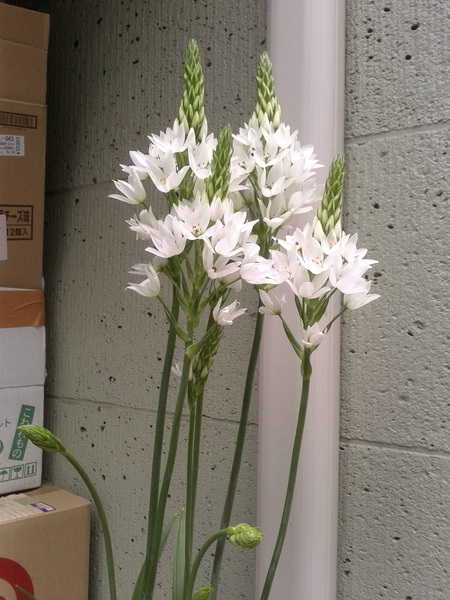
Ornithogalum thyrsoides (chinkerinchee)
Japanese name: オーニソガラム シルソイデス
Scientific name: Ornithogalum thyrsoides
[Overview]
A perennial about 45–60 cm tall.
It has a bulb.
The bulb is poisonous.
The leaves arise from the base in a rosette; they are linear-lanceolate, about 15–35 cm long and 5 cm wide, and thick.
The leaves die back after flowering, and the plant goes dormant in summer.
A raceme at the tip of a flower stalk about 20–50 cm tall bears 15–35 flowers.
The flowers are white, 2 cm across, with 6 tepals.
The fruit is a capsule.
[Cultivation]
Propagate by dividing the bulbs.
It can be left in place for several years.
It prefers sandy soil that is sunny, well drained, moisture-retentive and well aerated.
It dislikes excess moisture.
During leafless dormancy it is better kept shaded and on the dry side, so when planting in the ground, plant it under deciduous trees or among summer-growing plants.
For potted plants, water thoroughly when the soil surface dries during the growing period, and during dormancy water just enough that the soil does not dry out completely.
For plants in the ground, rainfall is sufficient.
Apply compost as base fertilizer, and for plants left in place in the ground, apply a small amount of compost in winter.
There are no particular pests or diseases, but soft rot can occur if the soil is too wet.
Details
Japanese: オーニソガラム シルソイデス
Translated from our Japanese encyclopedia. If anything differs, the Japanese page is correct.