
Plant Encyclopedia

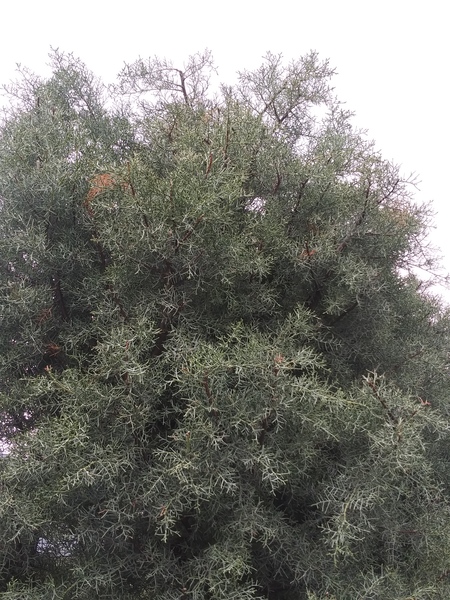
Cupressus arizonica (Arizona cypress)
Japanese name: アリゾナイトスギ
Scientific name: Cupressus arizonica
[Overview]
An evergreen coniferous tree 10–25 m tall, with a trunk about 50 cm in diameter.
The crown is conical at first and becomes broadly columnar with age.
The leaves are densely arranged in decussate pairs; they are grayish green to grayish blue-green scale leaves, and needle-like on young trees.
There are male and female flowers, and the female flowers form cone-like inflorescences.
The fruit is a spherical to ovoid cone 1.5–3.3 cm long, with 6–8 scales, and ripens in the second year.
The cones stay closed for a long time and open to release the seeds only after the branches die, for example in a forest fire.
[Cultivation]
Propagate by cuttings.
It is somewhat tender to cold, so it is suited to outdoor cultivation south of Kanto; avoid cold winter winds.
It is also unsuitable for heavy-snow regions, because the branches break.
It prefers sunny, well-drained, fertile soil.
The roots are shallow and the tree topples in strong wind, so avoid strong winds.
It dislikes being transplanted as a mature tree.
The leaves wither if the plant runs short of water, but if conditions are too humid the inside of the tree becomes stuffy and pests and diseases occur easily.
For plants in the ground, rainfall is sufficient except when sunny summer weather continues and the soil dries out.
Apply organic fertilizer around the tree as fertilizer in winter.
The natural shape is to be enjoyed, so pruning is not particularly necessary, but in spring you may thin out branches and pinch the leaf tips to keep the inside of the tree from becoming stuffy.
Sooty mold can occur.
Details
Japanese: アリゾナイトスギ
Translated from our Japanese encyclopedia. If anything differs, the Japanese page is correct.