
Plant Encyclopedia

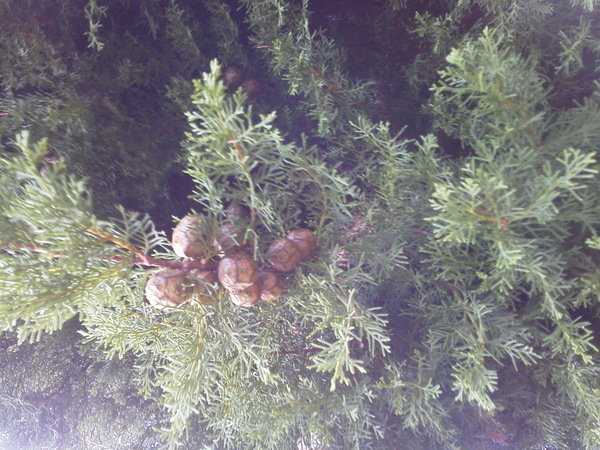
Cupressus sempervirens (Mediterranean cypress, "Hosoitosugi")
Japanese name: ホソイトスギ (細糸杉)
Scientific name: Cupressus sempervirens
[Overview]
An evergreen coniferous tree up to 35 m tall.
It is very long-lived, and some trees are said to be over 1000 years old.
The crown is narrowly conical to cylindrical.
The bark is brown and splits into long, thin vertical strips.
The leaves are densely arranged in decussate pairs and are usually dark green scale leaves, though they sometimes become needle-like.
There are male and female flowers, and the female flowers form globose inflorescences.
The fruit is a globose to ovoid cone 2.5–3.5 cm long, with 8–14 scales, and ripens in the second year.
[History]
In its native range it is deeply tied to culture, and is also known from Van Gogh's painting "Cypresses."
[Uses]
The wood is used for construction and other purposes.
[Cultivation]
Propagate by cuttings.
It is somewhat sensitive to cold, so it suits outdoor cultivation in Kanto and areas to the south, and cold winter winds should be avoided.
Heavy-snow regions are also unsuitable because the branches break.
It prefers sunny, well-drained, fertile soil.
The roots are shallow and it falls over in strong wind, so avoid strong winds.
It dislikes being transplanted when mature.
The leaves wither if it runs short of water, but if it is too humid the inside of the tree becomes stuffy and pests and diseases occur easily.
For plants in the ground, rainfall is sufficient except when sunny weather continues in summer and the soil dries out.
Apply organic fertilizer around the plant as fertilizer in winter.
To enjoy the natural tree form, pruning is not particularly necessary, but thinning branches and pinching leaf tips may be done in spring to keep the inside of the tree from becoming stuffy.
Sooty mold can occur.
Details
Japanese: ホソイトスギ(細糸杉)、セイヨウヒノキ(西洋檜)、イトスギ(糸杉)、セイヨウイトスギ(西洋糸杉)、イタリアンサイプレス、イタリアイトスギ
Translated from our Japanese encyclopedia. If anything differs, the Japanese page is correct.