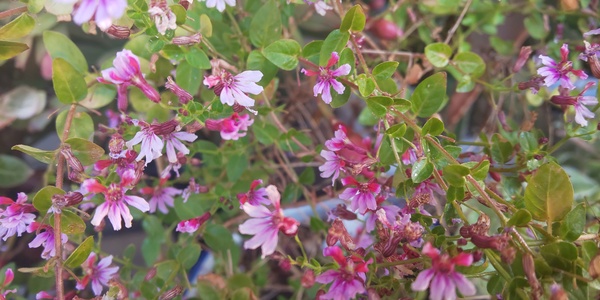
Japanese name: クフェア ラモシッシマ Scientific name:Cuphea ramosissima
[Overview]
An evergreen shrub.
It is tender to cold, so it is also treated as an annual.
It branches well and grows into a mound 25–40 cm tall and 30–45 cm wide.
The leaves are simple and decussate (opposite, each pair at right angles to the last), ovate to oblong, about 1–2 cm long, with entire margins.
The flowers are borne singly at the stem tips and in the leaf axils; they are about 1 cm across, purplish pink, and 6-petaled, spreading like a fan, with the 2 petals at the upper edges in a darker color.
The calyx is a slender tube with 6 lobes and a swollen base.
The fruit is a capsule.
[Cultivation]
Propagate from seed.
The optimum germination temperature is high, 22–25°C, so sow in late April to May.
To overwinter it, keep it at 5°C or above in a warm, sunny place indoors.
It prefers a sunny, well-drained, fertile soil.
In poor light it becomes leggy and flowers poorly.
Be careful not to overwater; from spring to autumn, water thoroughly when the soil surface dries, and keep it on the dry side in winter.
From spring to autumn, place slow-release fertilizer on the soil.
Remove spent flowers promptly.
There are no particular pests or diseases.