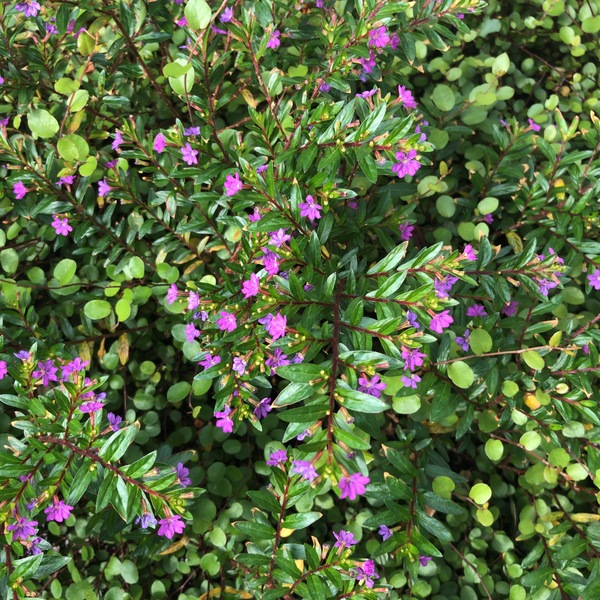
Japanese name: メキシコハナヤナギ Scientific name:Cuphea hyssopifolia
[Overview]
An evergreen perennial to subshrub 50–60 cm tall.
It branches well and grows densely.
The stems are densely covered with soft hairs; when young they are green, often tinged with red, and later become woody.
The leaves are simple and decussate (opposite, at right angles to the next pair), lanceolate to linear, 2.5–3.5 cm long and 0.3–0.7 cm wide, with entire margins.
The flowers are solitary at the stem tips or in the leaf axils, purple, 6-petaled, about 1 cm across.
The calyx is a slender tube with 6 lobes and a rounded swelling at the base.
The fruit is a capsule.
[Cultivation]
Propagate from seed, by cuttings, or by division.
It can overwinter outdoors in regions without frost.
It prefers fertile, sunny, well-drained soil.
In poor light it becomes leggy and flowers poorly.
For potted plants, water thoroughly when the soil surface dries; for plants in the ground, rainfall is sufficient unless summer brings a long sunny spell and severe dryness.
From spring to autumn, place slow-release chemical fertilizer on the soil.
Pests include aphids and scale insects.