
Plant Encyclopedia

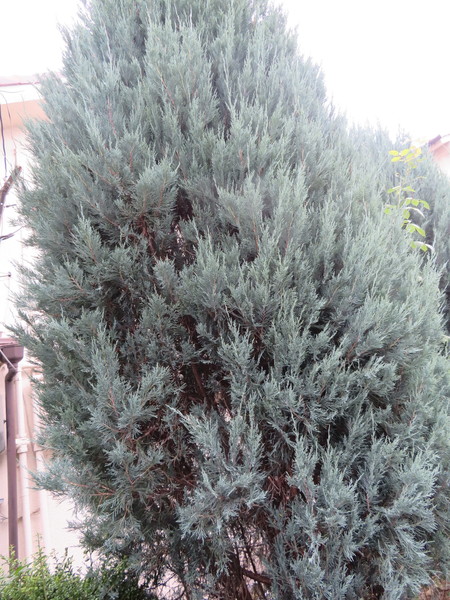
Juniperus scopulorum (Rocky Mountain juniper)
Japanese name: コロラドビャクシン
Scientific name: Juniperus scopulorum
[Overview]
An evergreen coniferous tree reaching 15 m in height and 1 m in trunk diameter, often found in its native range in dry, rocky places in the mountains.
The crown is conical.
The bark is reddish brown, with vertical fissures, and peels off thinly.
The leaves are in decussate opposite pairs, scale-like, 0.2 cm long, pressed flat against the branch, pointed at the tip, and yellowish green to dark green.
Young trees bear many needle-like leaves in whorls of 3, 0.5–1 cm long.
It is dioecious.
The fruit is a cone, ripening in autumn of the following year, spherical, 0.5–0.8 cm across, and bluish black with a white bloom.
[Cultivation]
Propagate by cuttings.
It prefers sunny, well-drained, somewhat dry, sandy soil.
Take care not to overwater; for potted plants, water thoroughly when the soil surface dries, and for plants in the ground, rainfall is sufficient.
Apply organic fertilizer in winter, and also place slow-release fertilizer on the soil in spring and autumn.
Pests and diseases include rust (akaboshi-byo) and scale insects.
[Notes]
Pear rust is a serious disease of pears, and because junipers serve as intermediate hosts of the rust, some local governments restrict the planting of junipers near pear orchards.
Details
Japanese: コロラドビャクシン
Translated from our Japanese encyclopedia. If anything differs, the Japanese page is correct.