
Plant Encyclopedia

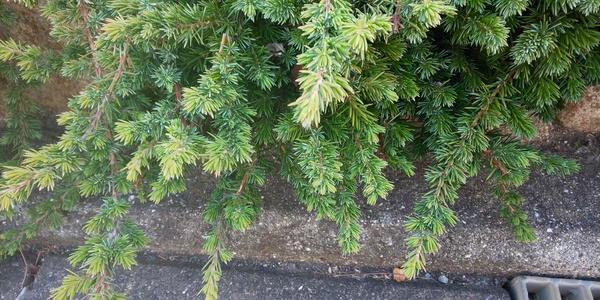
Juniperus conferta (shore juniper, "Hainezu")
Japanese name: ハイネズ (這杜松)
Scientific name: Juniperus conferta
[Overview]
An evergreen coniferous shrub found on sandy seashores, often growing in colonies.
The trunk creeps along the ground and spreads in all directions, branching, to a height of about 10–50 cm.
The leaves are densely arranged in whorls of three; they are straight, stiff needles about 1–2 cm long, triangular in cross section, with sharply pointed tips that hurt when touched.
The upper surface of the leaf has white stomatal bands in deep grooves.
It is dioecious.
The male flowers are clusters of stamens forming an egg-shaped to oblong shape, and the female flowers are egg-shaped, consisting of 3 female scales.
The cone is fleshy and berry-like, spherical, about 1 cm across; it ripens to purplish black with a whitish bloom in autumn of the following year and does not split open even when ripe.
The cone has no developed bracts, only 3 seed scales, and usually contains 3 seeds.
[Uses]
The cones are used medicinally.
[Cultivation]
Propagate by cuttings.
It prefers sunny, well-drained, poor, sandy soil on the dry side, but also grows in ordinary potting soil.
It tolerates bright shade, such as under pine woods.
Take care not to overwater; for potted plants and for plants in the ground less than 2 years after planting, water thoroughly when the soil surface dries, and for established plants in the ground, rainfall is sufficient.
Fertilizer is not particularly necessary, but while watching the plant's condition, apply organic fertilizer in winter if needed.
Pests and diseases include pear rust and scale insects.
[Notes]
Pear rust is a serious disease of pears, and because Chinese junipers and their relatives are an intermediate host of pear rust, some local governments restrict the planting of these trees near pear orchards.
Details
Japanese: ハイネズ(這杜松)
Translated from our Japanese encyclopedia. If anything differs, the Japanese page is correct.