
Plant Encyclopedia

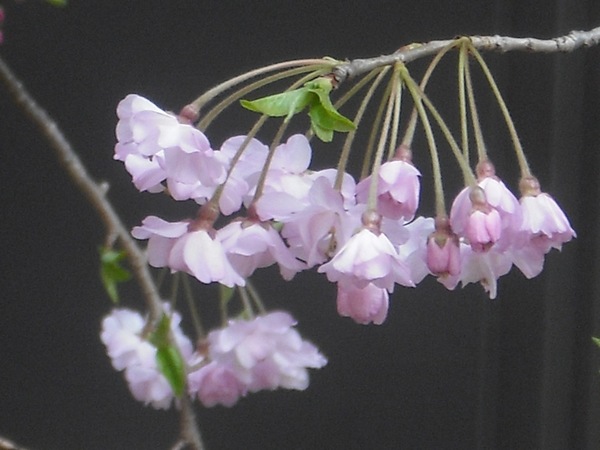
Cerasus spachiana ‘Plena-rosea’ ("Yaebenishidare")
Japanese name: ヤエベニシダレ (八重紅枝垂)
Scientific name: Cerasus spachiana ‘Plena-rosea’
[Overview]
A horticultural cultivar of the Edo-higan group.
The branches are long and weeping.
The leaves are linear-oblong, 9–11 cm long and 2.5–3 cm wide, with tips sharply pointed in a tail-like manner.
The upper surface of the leaves is glossy, with hairs on the midrib.
The undersides of the leaves are hairy, especially on the veins.
The leaf margins have low double serrations mixed with single serrations.
The petioles are densely covered with upward-pointing hairs.
It flowers before the leaves unfold.
The flowers are borne in umbels at the leaf axils, and are pale reddish purple, 2.5 cm in diameter.
There are 15–20 petals, which are slightly twisted.
The calyx tube is bell-shaped, slightly constricted in the middle.
The calyx lobes are triangular and serrated.
There is almost no flower stalk, and the pedicels are densely covered with obliquely ascending hairs.
[Cultivation]
Propagate by cuttings or grafting.
It prefers a sunny, well-drained location.
If you are concerned about it becoming a large tree in the garden, it is good to restrict the space in which the roots spread by using a fabric pot, in order to control the size of the tree.
While the plant is a young tree, protect it from frost by laying straw around the base, for example.
Also, it is better not to cut the branches needlessly unless necessary.
Because it is prone to many pests and diseases, care is needed.
Details
Translated from our Japanese encyclopedia. If anything differs, the Japanese page is correct.